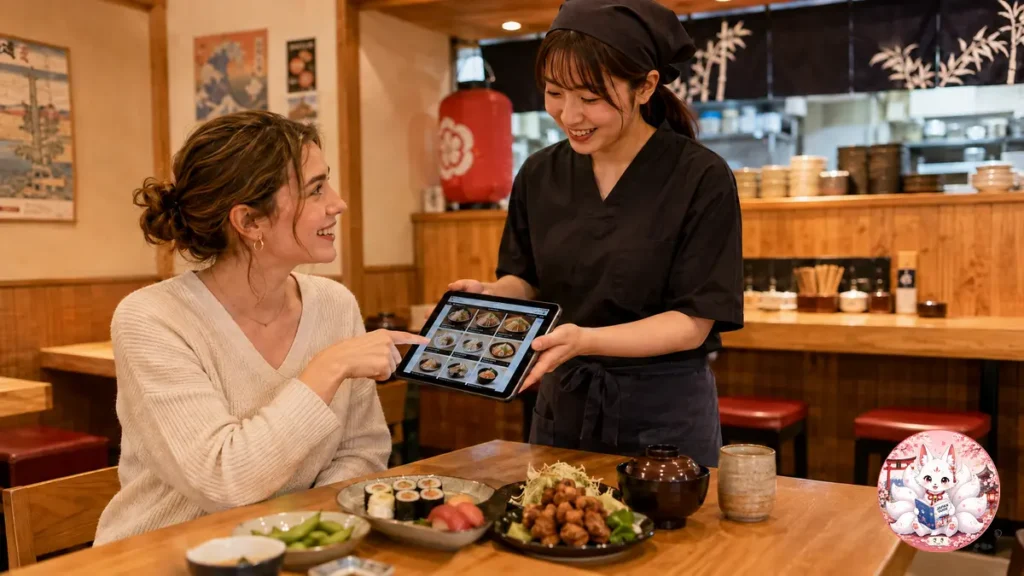
Ordering food in Japan is not difficult once you understand the system—but the system is not the same at every restaurant.
The 30-Second Answer
- Check for a line, sign-in sheet, or reception machine near the entrance.
- Unless the restaurant clearly has open seating, wait for a staff member to seat you.
- Look for a ticket machine, ordering counter, table tablet, QR code, call button, or paper menu.
- Use photos, item numbers, translation tools, or a short phrase to place your order.
- Keep your meal ticket, order number, pager, receipt, or table bill.
- Confirm whether you already paid, should pay at the register, or need to request the bill at the table.
- Check the accepted payment methods before ordering. Tipping is not normally expected at restaurants in Japan.
At one place, a server may take your order at the table. At another, you may use a tablet, scan a QR code, buy a meal ticket from a machine, or order and pay at a counter before sitting down.
For many first-time visitors, reading the menu is only part of the challenge. The more confusing questions are often: Where do I wait? Am I supposed to sit down? How do I place the order? Have I already paid? Where do I take the bill?
You do not need to memorize every restaurant system or speak fluent Japanese. You only need to identify how the restaurant in front of you works.
This guide takes you through the process from entering a restaurant to paying the bill.
If you are unsure, watch what other customers do and politely say “Sumimasen” to get a staff member’s attention.
Last checked: August 18, 2026.
In this guide
- Before You Enter
- Wait for Instructions Before Sitting Down
- Identify the Ordering System
- Place Your Order
- Useful Japanese Phrases for Restaurants
- What Is the Small Dish You Did Not Order?
- Essential Dining Manners
- Pay the Bill
- Common Mistakes to Avoid
- First Restaurant Checklist
- Frequently Asked Questions
Before You Enter
Check How You Can Pay
Many restaurants accept credit cards, transportation IC cards, or mobile payments, but acceptance is not universal. A small restaurant or older ticket machine may be cash-only. Other businesses may be completely cashless.
Look for payment logos near the entrance, register, or ticket machine. A displayed card network does not guarantee that every foreign-issued card will be approved, so keep another payment method available.
If you need yen, see Life with Saki’s guide to withdrawing cash in Japan with a foreign card. If you are deciding which visitor IC card to get, compare Welcome Suica and TOURIST PASMO.
Arrive on Time for a Reservation
If you reserved a table, arrive by the specified time. Contact the restaurant as soon as possible if you will be late or cannot come. A small restaurant or course-menu venue may prepare seats and ingredients for the exact number of guests booked. Japan’s official tourism organization also asks visitors to be punctual and cancel reservations in advance when plans change in its guidance on customs and restaurant etiquette.
Without a reservation, check for a line, reception machine, or sign-in sheet. At some popular restaurants, you enter your party size into a machine and receive a number. Your number may appear on a screen or be called in Japanese, so keep the ticket and watch the queue.
Do Not Leave Serious Food Restrictions Until the Last Minute
If you have a severe food allergy, contact the restaurant before visiting whenever possible. A dish name or photo cannot tell you everything about its stock, sauce, seasoning, cooking oil, garnish, or possible cross-contact with shared equipment.
The word “vegetarian” may also be interpreted differently. A dish without visible meat can still contain fish stock, bonito flakes, gelatin, or another animal-derived ingredient. JNTO’s vegetarian and vegan guide specifically warns that stocks and sauces commonly contain ingredients that are easy to miss.
Do not rely on one translated sentence as proof that a dish is safe. Show a clearly written card naming the exact ingredients you must avoid and explaining any cross-contact concerns. Ask whether the restaurant can accommodate them.
If the staff cannot confirm what is in the dish or how it is prepared, do not assume it is safe. A short Japanese phrase can begin the conversation, but it cannot guarantee allergy safety.
Step 1: Wait for Instructions Before Sitting Down
At many full-service restaurants, you tell the staff how many people are in your party and wait to be shown to a table. Look for signs such as “Please wait to be seated” or 受付, meaning reception.
You can answer a question about party size with one of these phrases:
| Party size | Japanese | Romaji |
|---|---|---|
| One person | 一人です | Hitori desu. |
| Two people | 二人です | Futari desu. |
| Three people | 三人です | Sannin desu. |
Holding up the number with your fingers is also fine.
There are exceptions. At some ramen shops, food courts, fast-food restaurants, and cafes, you order from a machine or counter before choosing a seat. Check the signs and observe the customer flow instead of assuming that every empty seat is available.
Some traditional restaurants and tatami seating areas require you to remove your shoes. Look for a raised floor, shoe rack, slippers, or staff instructions before walking farther inside.
Step 2: Identify the Ordering System
Do not look only at the table. The key instructions may be beside the entrance, ticket machine, or register.
Table service
How it works: Choose at your seat and call the server when ready
Check: Staff may not return repeatedly to ask if you are ready
Look for: Paper menu, call button, or a server who approaches the table
Table tablet
How it works: Select a language, items, quantities, and submit the order
Check: Items left in the cart may not have been sent
Look for: A fixed device at each table
QR ordering
How it works: Scan it with your phone and order through the menu page
Check: Connection, table number, and final confirmation
Look for: A QR code at the table
Ticket machine
How it works: Choose, pay, and collect a meal ticket
Check: You may need to hand over the ticket, or the order may be sent automatically
Look for: Buttons or a touchscreen near the entrance
Counter ordering
How it works: Order and pay, then take a number or pager
Check: Pickup point and tray-return area
Look for: A register or ordering line before the seating area
Restaurant-specific system
How it works: Follow the table screen and store instructions
Check: Counting plates and requesting checkout vary by restaurant
Look for: Conveyor belt, plate slot, checkout scanner, or other equipment
Even different locations of the same chain can use different equipment. Follow the instructions in front of you rather than relying entirely on what happened at another branch.
Step 3: Place Your Order
Ordering From a Server
When you are ready, press the call button if the table has one. If there is no button, wait until a staff member is nearby and say:
Sumimasen. — Excuse me.
Calling a server this way is normal in Japan. You do not need to wait for someone to check on the table several times.
If you cannot pronounce the dish name, point to the item and say:
Kore o onegaishimasu. — This one, please.
To order one item, say:
Kore o hitotsu onegaishimasu. — One of this item, please.
You can also show the quantity with your fingers. When the order is complete, say:
Ijo desu. — That is all.
Ordering on a Table Tablet
First, check whether the tablet has an English or other language setting. An English interface can make navigation easier, but item descriptions and limited-time menus may not be identical in every language.
Select the dish, quantity, size, toppings, and set options. Then press the final Order, Submit, or 注文する button. Adding an item to the cart may not send it to the kitchen.
Check the order history or confirmation screen. If an option is unclear, call a staff member instead of guessing and submitting something you did not intend to order.
Ordering With a QR Code
Scan the restaurant’s QR code at the table. Confirm the restaurant name and table number shown on the page before adding items.
QR ordering may require your own phone and an internet connection. If the page will not load, your battery is low, or the menu does not support a language you can use, ask whether the staff can provide another way to order.
If you want mobile data ready for maps, translation, and QR menus as soon as you arrive, see Life with Saki’s comparison of eSIM options for Japan.
As with a tablet, make sure you complete the final submission step. A dish sitting in an online cart has not necessarily been ordered.
Ordering From a Ticket Machine
Use this as a general sequence:
- Look for an English or language-selection button.
- Choose the dish, size, toppings, and any set options.
- Follow the screen or machine instructions to pay.
- Collect the meal ticket, receipt, and change.
- Give the ticket to a staff member or wait for your number, depending on the restaurant.
On an older button-style machine, you may insert cash first so the available item buttons light up. A newer touchscreen or cashless machine may ask you to select the food before paying. Follow the machine rather than assuming the order is always the same.
売切 means sold out. If you feel rushed because a line is forming behind you, look at the menu before joining the line or step aside briefly to choose another dish.
Do not throw away the ticket immediately. At some restaurants, you hand it to a staff member. At others, the machine sends the order directly to the kitchen and your ticket or receipt shows the number that will be called.
Ordering and Paying at a Counter
At a fast-food restaurant, cafe, or food court, you may order and pay before sitting down. Keep the receipt, number card, or pager and wait in the designated area.
Chopsticks, spoons, water, and condiments may be self-service. After eating, check whether you need to return the tray and dishes to a marked collection point.
Useful Japanese Phrases for Restaurants
You do not need perfect sentences. A short phrase, a polite tone, and pointing to the relevant menu item are often enough.
| What you want to say | Japanese | Romaji |
|---|---|---|
| Excuse me | すみません | Sumimasen. |
| Do you have an English menu? | 英語のメニューはありますか? | Eigo no menyu wa arimasu ka? |
| I have not decided yet | まだ決めていません | Mada kimeteimasen. |
| This one, please | これをお願いします | Kore o onegaishimasu. |
| One of this item, please | これを一つお願いします | Kore o hitotsu onegaishimasu. |
| What do you recommend? | おすすめは何ですか? | Osusume wa nan desu ka? |
| That is all | 以上です | Ijo desu. |
| The bill, please | お会計をお願いします | Okaikei o onegaishimasu. |
| Can I use this card? | このカードは使えますか? | Kono kado wa tsukaemasu ka? |
| Can we pay separately? | 別々に払えますか? | Betsubetsu ni haraemasu ka? |
Pointing to a photo or item number and saying “Kore o onegaishimasu” is one of the easiest ways to order. Do not use the photo alone to judge ingredients or portion size.
What Is the Small Dish You Did Not Order?
At an izakaya, a small appetizer called otoshi may arrive before your food or with the first drinks. It is not necessarily complimentary. Its price can function as a per-person table charge and appear on the final bill.
Not every izakaya uses the same system. A restaurant may instead have another table charge, service fee, or late-night surcharge. Check the menu or entrance information before ordering if additional charges matter to your decision. JNTO’s restaurant-etiquette guidance also explains that some restaurants charge for the table and that an izakaya appetizer may be part of that charge.
If you have a food allergy, remember that the otoshi can also contain an ingredient you need to avoid. Explain the restriction as early as possible, not after the dish has been served.
You may also receive a damp hand towel called an oshibori. It is primarily for cleaning your hands before eating. After using it, fold it loosely and return it to the tray or place it at the side of the table.
Essential Dining Manners
You do not need to memorize a long list of rules. These basics are enough for an ordinary meal:
- Do not leave chopsticks standing upright in a bowl of rice.
- Do not pass food directly from one pair of chopsticks to another.
- Use serving chopsticks or utensils when they are provided for shared dishes.
- Arrive on time for reservations and cancel promptly if you cannot go.
- Avoid ordering more than your group can reasonably eat. Add dishes gradually when the restaurant allows it.
- Avoid strong perfume at restaurants where subtle aromas are part of the experience, particularly some sushi restaurants.
If you are unsure, follow the restaurant’s instructions and observe the people around you. Consideration for the staff and other customers matters more than performing every custom perfectly.
Step 4: Pay the Bill
If You Already Paid
If you used a ticket machine or paid at the counter, there is usually no additional payment after the meal. Follow any instructions for returning a tray, pager, or other item. Additional orders may be handled separately.
If There Is a Bill at the Table
Many restaurants leave a small bill or payment slip at the table. You normally take it to the register near the exit when you are ready to leave. A slip placed face down is still your bill—do not throw it away or take it as a souvenir.
Table Payment and Self-Checkout
Some higher-end restaurants, hotel restaurants, and other venues handle payment at the table. Elsewhere, you may request checkout on a tablet or scan a table number, bill, or barcode at a self-payment machine.
If the process is unclear, say:
Okaikei o onegaishimasu. — The bill, please.
Ask before carrying the bill toward the exit if you are not sure where to pay.
Cash, Cards, and IC Cards
Accepted payment methods depend on the restaurant and terminal. Even if the entrance shows card acceptance, a ticket machine or special transaction may have different conditions. Keep cash or another backup in case a foreign-issued card is declined.
If your group wants separate checks, ask before payment begins. A restaurant may decline because of its register system, group size, or how busy it is. Be ready for one person to pay and settle the amount with the group afterward.
Do You Tip in Japan?
Tipping is not customary at ordinary restaurants in Japan. Pay the amount on the bill and thank the staff. Leaving cash on the table may be treated as money you forgot.
A service fee, table charge, otoshi, or late-night surcharge is different from a tip. If part of the bill is unclear, ask before paying. See JNTO’s official explanation of tipping in Japan for more context.
Common Mistakes to Avoid
- Walking past a reception machine or sign-in sheet and going directly to an empty seat.
- Assuming the restaurant has open seating before checking.
- Adding items to a tablet or QR cart without submitting the order.
- Selecting the wrong table number in a QR system.
- Leaving change, a meal ticket, receipt, order number, or pager at a machine.
- Assuming a meal ticket was sent automatically without checking whether staff need it.
- Treating an English menu or food photo as confirmation of allergy safety.
- Discovering only after ordering that your preferred payment method is not accepted.
- Throwing away the table bill because it looks like a receipt.
- Assuming otoshi is a free appetizer.
- Expecting separate checks to be available everywhere.
- Leaving a tip in cash on the table.
First Restaurant Checklist
- Check the line, reception machine, or sign-in sheet.
- Confirm the payment method before ordering.
- Find out whether you wait to be seated or order first.
- Identify the table, tablet, QR, ticket-machine, or counter system.
- Confirm that the order was submitted.
- Keep the ticket, number, pager, receipt, or bill.
- Confirm ingredients and cross-contact concerns for serious food restrictions.
- Check whether you pay at the register, table, or self-checkout machine.
- Keep a backup payment method.
- Do not leave a tip at an ordinary restaurant.
Frequently Asked Questions
Can I Order Without Speaking Japanese?
Often, yes. You may be able to use an English menu, photos, item numbers, a language setting on a tablet, or a translation app. Pointing to the item and saying “Kore o onegaishimasu” also works in many situations. Small restaurants and limited-time menus may not have English information.
Can I Sit at Any Empty Table?
Wait for staff unless open seating is clearly indicated. Ramen shops, food courts, and counter-service restaurants can work differently, so check the entrance before sitting down.
What If the Ticket Machine Is Only in Japanese?
Look for a language button, food photos, item numbers, or a menu posted outside. Ask staff for help rather than buying something at random. If people are waiting behind you, step aside briefly while choosing an alternative.
Is It Rude to Call a Server by Saying “Sumimasen”?
No. If there is no call button, saying “Sumimasen” when a staff member is nearby is a normal way to get attention. Avoid repeatedly shouting across the room or blocking a busy server’s path.
Why Was I Charged for an Appetizer I Did Not Order?
It may have been otoshi at an izakaya, which can function as a per-person table charge. Not every restaurant handles this the same way, so check the menu, signs, or staff explanation.
Can I Pay by Credit Card or Suica?
It depends on the restaurant and payment terminal. Check the logos near the entrance or register and ask before ordering if necessary. Keep another payment method in case a foreign-issued card is not approved.
Can We Split the Bill?
Some restaurants allow separate checks, while others do not. Ask before checkout. If separate payment is unavailable, have one person pay and settle the amount within the group afterward.
How Much Should I Tip?
You normally do not tip at restaurants in Japan. Pay the stated bill. Service fees, table charges, and otoshi are separate charges, not tips.
Final Takeaway
The most useful restaurant skill in Japan is not memorizing a long list of phrases. It is recognizing the ordering system in front of you.
Check how the restaurant handles its queue and seating. Identify whether you order from a server, tablet, QR code, ticket machine, or counter. Confirm that the order was submitted, keep the ticket or bill, and find out where payment happens.
The details vary by restaurant, so follow the current signs instead of relying only on a chain name or a previous visit. When you are unsure, a polite “Sumimasen” and a quick question are enough to get started.
Prefer an English-friendly guided food experience?
If you would prefer an English-friendly food experience with step-by-step guidance, compare Life with Saki’s seven cooking classes in Tokyo for first-time visitors. A cooking class is different from an ordinary restaurant meal, but it can be a comfortable way to learn about Japanese food and preparation with an instructor.
Related Guides
Japanese Convenience Store Guide
Learn how payment, food heating, utensils, ATMs, and other services work.
Find ATMs that support overseas-issued cards and avoid common withdrawal problems.
English-Friendly Cooking Classes in Tokyo
Compare sushi, ramen, home-cooking, and other hands-on classes for first-time visitors.