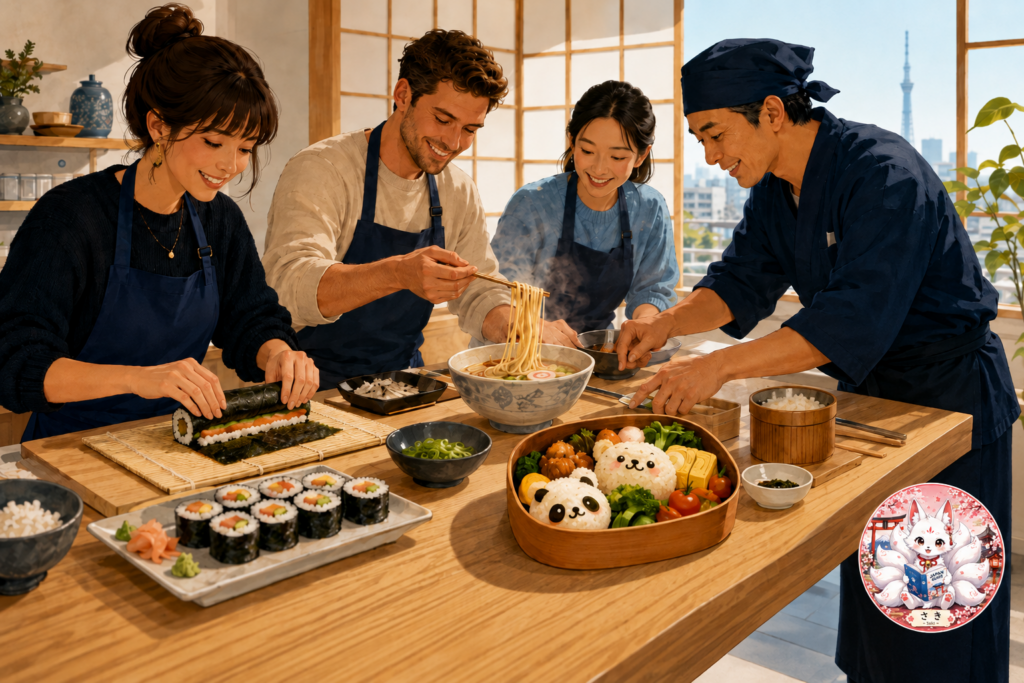
Tokyo has English-friendly cooking classes for sushi, ramen, home-style dishes, character bento, and more. But classes with similar names can offer very different experiences.
Some teach you to make noodles or dumplings. Others let you build a bowl of ramen in an hour using broth and ingredients prepared in advance. A shorter experience is not necessarily worse—the right choice depends on what you want to get out of your time in Tokyo.
That is why we compare not just what you make, but how much you actually cook. A listing may say “cooking class,” but the experience may involve cooking from scratch, hands-on preparation, or mostly assembly and customization.
If this is your first trip to Tokyo and you are not sure where to start, Sushi Making Tokyo in Asakusa is our top pick. We are not calling it the single best cooking class in the entire city. It earns our Best Overall spot for first-time visitors because it combines English instruction, solo-friendly booking, several dietary menu options, an easy-to-plan Asakusa location, and a substantial number of reviews and bookings.
If cooking is one of the main reasons for your trip, however, Ramen Masterclass offers more hands-on preparation. If you would rather explore the food people eat at home in Japan, Authentic Homestyle Japanese Cooking Class may be a better fit.
Below, we compare seven bookable English-friendly options by what you make, how long they take, how much of the cooking you do yourself, dietary options, location, and starting price.
Affiliate disclosure: This article contains affiliate links. If you book through them, we may earn a commission at no extra cost to you.
The Short Answer: Best Tokyo Cooking Class for Each Type of Traveler
- Best overall for first-time visitors: Sushi Making Tokyo in Asakusa
- Best for serious ramen lovers: Ramen Masterclass
- Best for Japanese home cooking: Authentic Homestyle Japanese Cooking Class
- Best for a Tsukiji-based sushi experience: Tsukiji Sushi Class
- Best for vegan and gluten-free travelers: Vegan & Gluten-Free Udon Class
- Best for families and photos: Tokyo Cute Bento
- Best for a quick, budget-friendly Shinjuku experience: Kabukicho Ramen Making Experience
Rather than booking the class that looks most popular, choose the one that best fits your schedule and what you want to learn—or simply enjoy.
Quick Comparison of 7 Cooking Classes in Tokyo
| Class | Best for | Area | Duration | Main experience | Starting price | Check before booking |
|---|---|---|---|---|---|---|
| Sushi Making Tokyo | First-time Tokyo visitors | Asakusa | 1 hr 40 min | Sushi rolls and nigiri | From ¥7,200 (about US$45) | Select the correct dietary menu |
| Ramen Masterclass | Serious ramen lovers | Ekoda, Nerima | 2 hr 15 min | Noodles, gyoza, and ramen finishing | From ¥16,358 (about US$103) | Two-person minimum; check how much broth preparation is hands-on |
| Homestyle Japanese Cooking | Travelers who want to make several everyday dishes | Near Shinjuku | 2 hr 30 min | A three- or four-dish Japanese meal | From ¥13,063 (about US$82) | Two-person minimum; preferred menu may not be guaranteed |
| Tsukiji Sushi Class | Travelers interested in Tsukiji and chef-led techniques | Tsukiji Outer Market | 1 hr 35 min | Five pieces of nigiri and one sushi roll | From ¥8,300 (about US$52) | This is a class in Tsukiji, not a market tour |
| Vegan & Gluten-Free Udon | Vegan and gluten-free travelers | Nishi-Nippori | 1 hr 30 min | Wheat-free udon making | From ¥7,125 (about US$45) | Choose udon only or udon with tempura |
| Tokyo Cute Bento | Families, couples, and photo lovers | Akasaka | 2 hr | Character bento such as panda or Shiba Inu | From ¥7,600 (about US$48) | Choose a design and seasonal menu |
| Kabukicho Ramen Experience | A quick, affordable activity in Shinjuku | Kabukicho, Shinjuku | 1 hr | Choosing broth and toppings, then finishing your bowl | From ¥5,077 (about US$32) | Broth, noodles, and much of the prep are done in advance |
Prices were checked on Klook’s Japan-facing pages on August 12, 2026. US dollar amounts use an approximate exchange rate of ¥159 to US$1. Prices vary by date, exchange rate, package, and promotions. Check the current price before booking.
How We Chose These Classes
We did not rank these classes by star rating alone. Newer activities with only a few reviews can easily show a perfect score, so their ratings are not directly comparable with long-running classes that have hundreds of reviews. After our top pick, the classes are organized by who they suit best—not as a strict second-to-seventh-place ranking.
For English-speaking travelers visiting Japan for the first time, we looked at:
- Whether English support is clearly stated on the booking page
- How much cooking a beginner actually does
- Whether the listing makes the difference between a class and a lighter food experience clear
- How easily the activity fits into a Tokyo itinerary
- Solo booking, minimum group size, and age requirements
- Information about vegan, vegetarian, gluten-free, halal, and allergy-related options
- What you make, eat, and take home
- Whether the time and price appear reasonable for the advertised experience
Sushi Making Tokyo: Best Overall for First-Time Visitors
For a first cooking experience that fits naturally into a day of sightseeing, Sushi Making Tokyo in Asakusa is our top pick. This is not an absolute ranking of every cooking class in Tokyo. It is our Best Overall choice based on the things that tend to matter most on a first visit.
With guidance from English-speaking staff, you make two styles of sushi: rolled sushi and nigiri. The class also includes a short quiz about sushi history, so the session offers more context than simply shaping the rice and sitting down to eat.
At the time of checking, Klook showed a 5.0 rating from 944 reviews and more than 8,000 bookings. That gives travelers more information to judge than any other class in this comparison.
The location is another advantage. The venue is near Kaminarimon, making it easy to pair the class with Asakusa Station and Senso-ji. You do not need to cross the city solely for the activity, and at 1 hour 40 minutes, it will not take over an entire morning or afternoon.
The booking page also separates Standard / Gluten-Free, Vegan / Vegetarian, Halal, and Allergies into menu categories. That makes the available choices easier to find before booking than at classes that only say dietary requests may be discussed.
Best fit: First-time Tokyo visitors, solo travelers, anyone planning a day in Asakusa, and travelers who want clearly labeled dietary menu options.
Consider another class if: You care most about knife work and a sushi chef’s demonstration, in which case Tsukiji may suit you better. Choose one of the longer ramen or home-cooking options if learning techniques you can revisit at home is your priority.
Ramen Masterclass: Best for Serious Ramen Lovers
Ramen Masterclass is one of the most expensive options on this list. Still, it has a clear appeal for travelers who want to understand ramen as a dish rather than treat it as a quick vacation activity.
You use professional noodle-making and noodle-cooking equipment while preparing noodles, toppings, and gyoza. The instructor, Yoshi Shishido, has experience running a ramen restaurant overseas and working in a ramen shop in Tokyo. The class is conducted in English, covers the background and process behind ramen, and includes recipes to take home.
There is one important point to understand about the broth. Klook’s listing says participants prepare the signature chicken tonkotsu broth, while the class flow focuses mainly on ingredient preparation and ramen assembly. If making the broth itself is important to you, check with the operator before booking to confirm exactly how much of that process is hands-on.
Even so, the hands-on work goes well beyond choosing precooked noodles and broth and arranging toppings. You make noodles and dumplings, complete your bowl, and leave with recipes. Think of the higher price as paying for more instruction and greater potential to use what you learned after your trip.
Klook requires a booking for at least two people, so this option works better for couples and friends than for solo travelers.
Who gets the most value: Ramen-loving couples or groups of friends who want to make noodles and gyoza and value technical explanations in English.
It may not justify the price if: You only have an hour available or would be happy simply customizing and eating your own bowl.
Authentic Homestyle Japanese Cooking: Best for Everyday Japanese Food
Sushi and ramen are obvious choices on a Japan trip, but neither fully represents what people eat at home. If you are curious about everyday meals and want to prepare several dishes rather than one famous specialty, this home-cooking class deserves a look.
Over about 2 hours 30 minutes, you make three or four dishes and then eat the finished meal together. Listed menus include okonomiyaki with yakisoba; gyoza with takoyaki; sushi rolls with teriyaki; and set meals featuring items such as beef rolls or salmon. Its strength is the chance to experience combinations that may include miso soup and side dishes—not just one headline dish.
Sessions are listed near Shinjuku at 11:00 a.m. or 5:00 p.m. If you are staying in the area, the class is easy to fit around shopping or a rainy day without adding a long trip across Tokyo.
Your first-choice menu may not always be available. The listing explains that an earlier group’s selection can affect the menu offered on the same date. Klook also requires at least two participants. After choosing a date, check the actual menu and meeting point rather than booking based only on a dish shown in the listing photos.
Best suited to: Travelers who want to explore the everyday Japanese table, prepare several dishes, and are staying near Shinjuku with at least one companion.
The deciding question: Instead of asking only what you want to eat in Japan, consider what you would be most interested in making again after you return home.
If your accommodations have a kitchen and you want to try the dishes again while you are still in Tokyo, see Life with Saki’s beginner’s guide to shopping at a Japanese supermarket before buying ingredients.
Tsukiji Sushi Class: Best for a Chef-Led Sushi Experience in Tsukiji
If the Asakusa sushi class is the broadly accessible choice for beginners, this option is for travelers who care more about the Tsukiji setting and chef-led techniques.
The class takes place in the Tsukiji Outer Market. With an English-speaking guide and a sushi chef, you make five pieces of nigiri and one sushi roll. The program also includes details such as grating fresh wasabi, using a wooden hangiri rice tub, and watching a knife demonstration—elements that connect the activity more closely to the work of a sushi restaurant.
Klook lists the experience at 1 hour 35 minutes, an easy length to combine with a morning in Tsukiji or plans in nearby Ginza.
The reason to book is not simply that you get to make sushi. It is the chance to connect fish, knives, wasabi, and seasoned rice with a chef’s explanations in a place strongly associated with Tokyo’s food culture.
At the time of checking, Klook showed 27 reviews and more than 800 bookings. Its 5.0 rating is encouraging, but the sample is much smaller than Asakusa’s. The rating alone does not make it the stronger all-around choice.
This is primarily a sushi class located in Tsukiji, not a guided tour of the market. Read the package details carefully if a market tour is what you expect.
This works best when: Tsukiji is already on your itinerary and you want a short class with a chef’s demonstration, traditional tools, and more culinary context.
Asakusa or Tsukiji? Choose Asakusa for the larger booking history, clearer dietary menu choices, and straightforward solo participation. Choose Tsukiji for the setting and chef-led process.
Vegan & Gluten-Free Udon: Best for Vegan and Gluten-Free Travelers
For vegan or gluten-free travelers, a general statement such as “dietary requests available” may not answer the questions that matter. You still need to know whether the broth contains fish and whether the noodles contain wheat.
This Nishi-Nippori class is built around making udon without wheat or animal-derived ingredients. You mix, roll, and cut the dough with instruction in English, then receive a recipe booklet to take home. Klook lists an udon-only package and another with tempura, both lasting about 1 hour 30 minutes.
It is one of the more affordable options in this comparison, yet the experience still has a clear purpose: you make a dish designed for your dietary needs from the beginning instead of asking for a standard recipe to be adapted.
Nishi-Nippori is less central to a typical sightseeing plan than Asakusa or Shinjuku, but it is accessible on the JR Yamanote Line and other train lines. If dietary compatibility is your first priority, the location alone should not rule it out.
Klook showed six reviews and more than 50 bookings when checked. A 5.0 score is positive, but the sample remains too small to compare directly with an established class that has hundreds of reviews.
A strong match for: Travelers who need both vegan and gluten-free food, want to roll and cut noodles themselves, or would value a recipe booklet for making the dish again.
Why it stands out: The dietary requirements are central to the class rather than an adjustment to a standard menu.
Tokyo Cute Bento: Best for Families and Photos
For families or couples who care more about creating something together than mastering a difficult technique, Tokyo Cute Bento in Akasaka is an easy option to understand.
You choose from designs such as a panda, Shiba Inu, or a seasonal character, then arrange rice and side dishes into a character bento. Tools, ingredients, aprons, and step-by-step guidance are provided. The listing welcomes beginners, solo travelers, and families.
After the cooking, there is time to photograph your finished bento using props and lighting. You can record the result properly before it becomes lunch.
This is not the deepest class for Japanese knife skills, broth, or noodle making. Its appeal is different: you participate in both kawaii culture and bento culture instead of only seeing them from the outside. Children can finish a creation that feels like their own, while adults leave with a very recognizable travel photo.
The Akasaka location works well with plans in Ginza, Roppongi, Shibuya, or Shinjuku. At the time of checking, Klook listed a two-hour duration, a 5.0 rating from 80 reviews, and more than 600 bookings.
Good choice for: Families, couples, solo travelers looking for an approachable class, and anyone who wants a photogenic finished result.
Look elsewhere if: Your main goal is to learn techniques such as knife work, dashi making, or noodle making for use at home.
Kabukicho Ramen Making Experience: Best for a Quick, Affordable Activity in Shinjuku
Maybe you do not have room in your itinerary for a long class, but you would still like a food activity that doubles as a meal in Shinjuku. That is where the Kabukicho Ramen Making Experience makes sense.
The session lasts one hour. You choose from salt, soy sauce, and spicy broth, cook the noodles, add your preferred toppings, and finish your own bowl. Klook lists it as From ¥5,077 (about US$32), the lowest starting price among these seven options, and you can eat the ramen as your meal afterward.
This is a lighter, one-hour hands-on ramen experience rather than a from-scratch cooking class. The broth, noodles, and much of the other preparation are completed in advance. Your main tasks are cooking the noodles, choosing the flavor and toppings, and finishing and plating the bowl.
The contrast with Ramen Masterclass is straightforward. The masterclass lasts 2 hours 15 minutes, includes making noodles and gyoza, and provides recipes. Kabukicho’s strengths are its one-hour duration, lower price, Shinjuku location, solo-friendly setup, and ability to double as a meal. It is for travelers who would rather talk with the host and build a bowl to their taste between sightseeing stops than take home a deeper set of cooking skills.
The venue is Shinjuku Ale in Kabukicho. It has a bar-style setting in an area known for nightlife. If you are bringing children, check the eligible ages, daytime sessions, venue atmosphere, and exact entrance before booking.
It makes sense for: Travelers staying in Shinjuku, visiting alone, short on time, watching their budget, or hoping to customize ramen and count it as a meal.
Masterclass or Kabukicho? Choose Ramen Masterclass for noodle making, gyoza, and take-home recipes. Choose Kabukicho for the one-hour format, price, location, and ease of joining solo.
Cooking Class vs. Cooking Experience: What Is the Difference?
Booking platforms may place both under the “cooking class” category. Instead of choosing by the label alone, look at whether the class includes from-scratch cooking, hands-on preparation, or mainly assembly and customization. That distinction tells you much more about what you will get from the experience.
Classes that teach skills you can take home
These classes include processes such as cutting ingredients, making noodles, or completing several dishes together—steps that are useful if you want to recreate the food later. Ramen Masterclass, Authentic Homestyle Japanese Cooking, and Vegan & Gluten-Free Udon fit most closely in this group.
Classes that combine food and culture
Here, the location, tools, background, or photography add value alongside the cooking. Sushi Making Tokyo in Asakusa, Tsukiji Sushi Class, and Tokyo Cute Bento belong in this group.
Short assembly and customization experiences
These use ingredients prepared in advance so you can finish a dish in less time. Kabukicho Ramen Making Experience is the clearest example. It is lighter than a from-scratch class, but that is balanced by a convenient location, a lower price, and the ability to fit it into a busy sightseeing day and use it as a meal.
The longest class is not automatically the best class for every traveler. Prioritize the number of cooking steps if you want to make the dish at home, the location and photo opportunities if you want a memorable activity, or the duration if your itinerary is already full.
6 Things to Check Before Booking
1. Final price
The lowest price shown on a listing may not match your preferred date. Check the final total after selecting the number of participants, time, menu, and any extras such as an alcohol package.
2. Solo booking and minimum group size
An activity may be described as a join-in group but still require at least two people during checkout. Enter your date and group size first to confirm whether you can buy a single spot.
3. Dietary restrictions and allergies
Vegetarian, vegan, and halal do not mean the same thing, and a meat-free dish may still contain fish-based dashi. Halal-friendly is also not the same as halal-certified. Gluten-free ingredients do not guarantee that shared soy sauce, frying oil, knives, cutting boards, or work surfaces are free from cross-contact. For a medically strict allergy or restriction, get a direct answer from the operator rather than relying only on a booking-page label.
4. Children and the venue
Look beyond a general “family-friendly” description. Check the minimum age, guardian fees, whether children use knives or heat, the type of venue, and the time of day.
5. Cancellation deadline and late-arrival policy
“Free cancellation” does not necessarily mean you can cancel until the class begins. Confirm the deadline in Japan time, whether late arrivals can still join, and when a refund is available.
6. What you actually cook
Read the class flow rather than relying on the product name. Check whether you cut ingredients, make noodles, cook food, or mainly assemble and plate it. If recreating the dish at home matters to you, classes such as Ramen Masterclass and Vegan & Gluten-Free Udon clearly state that recipes are provided.
Frequently Asked Questions
How much does a cooking class in Tokyo cost?
For the seven activities in this comparison, Klook listed starting prices from ¥5,077 (about US$32) to ¥16,358 (about US$103) per person on August 12, 2026. Short assembly-style experiences tend to cost less, while small-group classes with more hands-on steps tend to cost more.
Can I take a Tokyo cooking class in English?
Yes. All seven options in this guide list English or English/Japanese support on their booking pages. In some classes, a sushi chef may speak Japanese while an English-speaking guide interprets. Beginner-friendly classes generally use demonstrations as well as verbal instructions.
Can solo travelers join?
Sushi Making Tokyo in Asakusa and Tokyo Cute Bento explicitly welcome solo travelers. Ramen Masterclass and Authentic Homestyle Japanese Cooking require at least two participants on Klook. Even if a class has availability, you may not be able to purchase one spot, so enter your group size before making plans around it.
Can children join?
Some classes accept children. Among these seven, Tokyo Cute Bento is the clearest family-oriented choice because the activity is approachable and includes time to photograph the finished bento.
Are vegan and gluten-free cooking classes available?
Yes. Vegan & Gluten-Free Udon in Nishi-Nippori has the clearest dedicated format. Sushi Making Tokyo in Asakusa also shows Vegan / Vegetarian, Gluten-Free, Halal, and other menu categories on its booking page.
Do you cook every ingredient from scratch?
Not always. In the Kabukicho Ramen Making Experience, the broth and many ingredients are prepared in advance. Ramen Masterclass includes substantially more hands-on preparation, including noodles and gyoza, but check the current class details if making the broth itself is important to you. Check the specific class flow, not just the list of foods you “make.”
Should I eat before the class?
Most of these classes let you eat the sushi, ramen, set meal, or bento you prepare. It will usually serve as a meal, so you may enjoy the class more if you eat lightly beforehand. Portion sizes and tasting formats vary, so check the package details if this matters to your schedule.
How to Make the Final Choice
If this is your first Tokyo trip and you want a combination of English instruction, solo participation, dietary menu choices, an easy Asakusa location, and a large body of reviews and bookings, Sushi Making Tokyo is our top pick. It is our Best Overall choice for first-time visitors—not a claim that it outranks every cooking class in Tokyo for every traveler.
If cooking itself is a major part of your trip and you want more hands-on work, consider Ramen Masterclass or Authentic Homestyle Japanese Cooking. They cost more than a short assembly experience, but devote more time to process and culinary context.
Choose Vegan & Gluten-Free Udon when dietary compatibility comes first, Tokyo Cute Bento for a family-friendly result you can photograph, or Kabukicho Ramen Making Experience for a one-hour activity in Shinjuku.
Do not ask only which class is the most popular. Ask what you want to keep after the trip: a new skill, a distinctly Tokyo photo, time with your family, or a meal you can eat with confidence. Once you know the answer, the right class becomes much easier to choose.