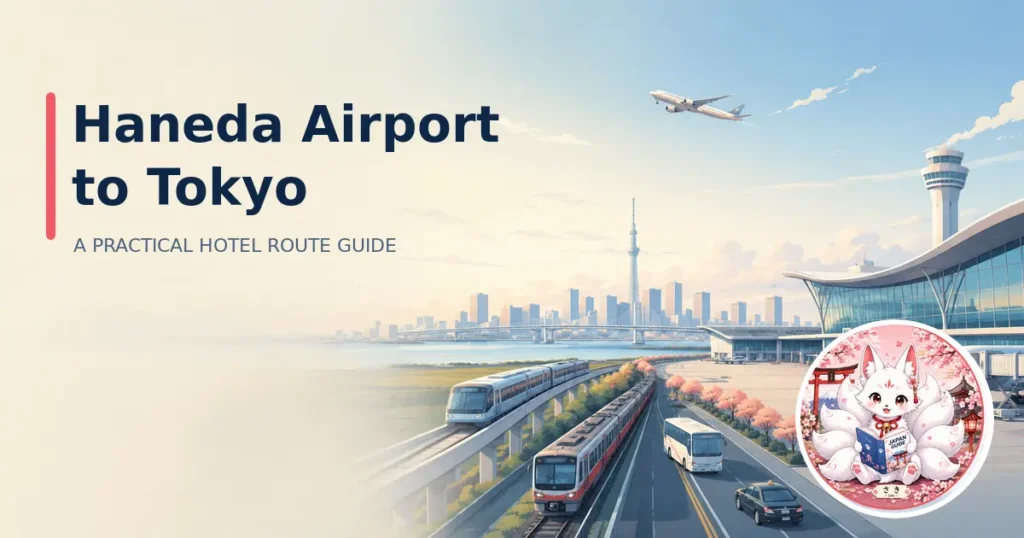
THE 30-SECOND ANSWER
After a long flight, the first decision at Haneda looks simpler than it is: one set of signs points to the Keikyu Line, another to the Tokyo Monorail. The better choice depends on the station beside your hotel—not on which sign you notice first.
- Shinagawa, Higashi-ginza, or Asakusa: check Keikyu first. Some trains continue directly onto the Toei Asakusa Line.
- Tokyo Station, Akihabara, or Ueno: the monorail to Hamamatsucho, then JR, is usually the easiest route to understand.
- Shinjuku or Shibuya: compare Keikyu via Shinagawa with the monorail via Hamamatsucho. A bus may be easier if it stops close to your hotel.
- Late arrival, several suitcases, children, or three to four travelers: compare the complete cost of a taxi or prebooked transfer before accepting a difficult train connection.
One rule prevents most mistakes: open your hotel map and find its nearest station and useful exit before you follow a railway sign.
Last checked: August 12, 2026. This article contains an affiliate link. If you book through it, I may earn a commission at no extra cost to you.
Before You Follow the Signs, Check One Detail
“Tokyo,” “Shinjuku,” and “Ginza” are areas, not precise transport destinations. Two hotels using the same area name can have different nearest stations, different exits, and very different walks with luggage.
Use the exact station shown on your booking confirmation or map. For example, a “Ginza” hotel may actually be easier from Higashi-ginza, Shimbashi, or Yurakucho. A “Tokyo Station” hotel may be on the Marunouchi side or the Yaesu side, which changes the final walk.
Do this in the arrival lobby: search your hotel name, confirm the nearest station, and screenshot the station exit. That small check is more useful than memorizing a single “best route from Haneda.”
If you have not booked yet, compare seven practical Tokyo areas for a first visit. Airport access matters, but so do the journeys you will make after check-in.
Compare the Four Main Ways into Tokyo
The fastest airport segment is not always the easiest hotel journey. Count the wait, transfer, station walk, luggage, and final exit—not only the minutes printed on a route map.
| Option | Usually best for | Main trade-off |
|---|---|---|
| Keikyu Line | Shinagawa; suitable through trains to Higashi-ginza and Asakusa | Different trains take different routes, so the destination display matters |
| Tokyo Monorail | Hamamatsucho and clear JR connections toward Tokyo, Akihabara, and Ueno | You normally carry your luggage through a transfer at Hamamatsucho |
| Airport bus | Hotels or stops reached with little walking; travelers with a large suitcase | Traffic and limited stop coverage make arrival time less predictable |
| Taxi or transfer | Late arrivals, groups, children, several bags, or hotels far from a station | Much higher total cost than rail; vehicle and luggage capacity still need checking |
Published journey times are examples, not hotel arrival promises. The next departure, train type, service disruption, transfer walk, and distance from the destination station can change the result.
Find the Station from Your Arrival Terminal
Both railways serve all three terminals, but the station layout is not identical. Follow the “Train” signs inside the terminal where your flight arrived; there is no reason to travel to another terminal first.
Terminal 1 and Terminal 2
Go down to B1F. The Keikyu and monorail ticket gates and platforms are on that level.
Keikyu uses one station for both terminals: Haneda Airport Terminal 1・2 Station. The monorail has a separate station for Terminal 1 and another for Terminal 2.
Terminal 3
For Keikyu toward central Tokyo, use the gate on the second-floor arrival-lobby level. The Keikyu gate on B2F is for travel to Terminals 1 and 2.
The monorail has gates on the second-floor arrival level and third-floor departure level. From international arrivals, the second-floor route is the straightforward choice.
Check the official Haneda train and monorail guide for current terminal-floor information.
Keikyu or the Monorail: What Actually Changes?
Keikyu: more direct possibilities, more attention before boarding
Keikyu runs directly to Shinagawa. Some trains continue beyond the Keikyu network onto the Toei Asakusa Line, allowing a no-transfer ride to stations such as Higashi-ginza or Asakusa.
The useful through service is also the reason you must check the train. Not every departure follows the same route; some head toward Kawasaki and Yokohama rather than Shinagawa. Before boarding, confirm that your live route shows Shinagawa, Sengakuji, or the required Asakusa Line station. If the display is unclear, show the station name to staff.
Monorail: one clear direction, then a JR transfer
Every airport departure heads toward the city terminal at Monorail Hamamatsucho. From there, JR trains continue toward Tokyo Station, Akihabara, Ueno, Shibuya, and other parts of the city.
The operator lists a fastest 13-minute trip from Terminal 3 to Hamamatsucho and average service about every five minutes. Those figures describe the monorail segment. Add the wait, the transfer walk, the JR ride, and the walk from your final station. See the official monorail access page for current examples.
Routes by Hotel Station or Area
These are starting points for a first visit, not fixed instructions for every departure. Check a live journey planner after you have collected your bags.
| Hotel station or area | Start by checking | Important detail |
|---|---|---|
| Shinagawa | Keikyu | Usually no transfer; confirm Konan or Takanawa side for your hotel |
| Tokyo Station | Monorail to Hamamatsucho, then JR | Check Marunouchi or Yaesu side before choosing an exit |
| Shibuya / Shinjuku | Keikyu via Shinagawa; compare monorail via Hamamatsucho | With a large bag, a nearby airport-bus stop may be easier than either transfer |
| Higashi-ginza | Keikyu through service | No transfer only on a suitable train continuing onto the Asakusa Line |
| Asakusa | Keikyu through service | Confirm the route shows no change before Asakusa |
| Ueno / Akihabara | Monorail to Hamamatsucho, then JR | Use a northbound JR Yamanote or Keihin-Tohoku train |
Tokyo Station: the station exit can matter as much as the rail route
The monorail to Hamamatsucho followed by JR is the simplest route to explain. Keikyu to Shinagawa followed by JR is also valid and may suit the next departure better. Once you reach Tokyo Station, however, a hotel on the Marunouchi side and a hotel on the Yaesu side can involve very different walks. Keep the hotel map open until you reach the correct exit.
Shinjuku and Shibuya: compare effort, not just minutes
Keikyu to Shinagawa followed by the JR Yamanote Line is a useful default. The monorail through Hamamatsucho also works. Both require a transfer into a major commuter flow, and both destination stations can be tiring with a full-size suitcase. If a bus stops at your hotel—or close enough that the final walk is obvious—the slower scheduled option may feel much easier.
Ginza: do not confuse Ginza with Higashi-ginza
A hotel may use “Ginza” in its name while sitting closer to Higashi-ginza, Shimbashi, or Yurakucho. Higashi-ginza is especially convenient when a Keikyu train continues directly onto the Toei Asakusa Line. For Ginza Station itself, another subway, a neighboring station, or a short taxi may produce the easier whole journey. Let the exact map pin decide.
Asakusa: direct does not mean every train is direct
On a suitable through train, you stay in the same car while the service changes from the Keikyu network to the Toei Asakusa Line. This is excellent with luggage, but it is not available on every departure. Confirm that your route shows zero transfers before Asakusa rather than assuming the next Keikyu train will work.
When an Airport Bus Is Easier Than the Train
A bus is not automatically better for an area just because the route name says “Shinjuku” or “Tokyo Station.” It becomes attractive when the exact stop removes a transfer and leaves a short, simple walk to your hotel.
- Compare the bus if you have one large suitcase, a child, or an older family member.
- Check the stop on a map; buses do not serve every hotel in an area.
- Check the service time and operating company for your arrival date.
- Allow for road traffic, and check that the operator accepts your luggage size and quantity.
The official Haneda bus page lists current routes, stops, and operators. For departures from Terminals 1 and 2, buy the required ticket at a machine. Terminal 3 has ticket machines and bus ticket counters. Buy before boarding.
When Door-to-Door Travel Is Worth Paying For
A private vehicle rarely wins on price for one daytime traveler with a manageable bag. What you are paying for is fewer decisions after the flight: no platform check, no transfer with luggage, and no search for the correct station exit.
COMPARE A DOOR-TO-DOOR OPTION IF
- You may leave arrivals after the last useful train or bus.
- Three or four people can divide the vehicle cost.
- You have several bags, a stroller, or a child who will be exhausted.
- Your hotel is far from a station or requires an awkward final walk.
Haneda offers flat-rate taxis for many—but not all—areas of Tokyo and Kanagawa. Expressway tolls are added, and meter rates apply in some areas. Check the official Haneda taxi information, then compare the complete price for your hotel address.
Check a private transfer price to your hotel →
Opens Kiwitaxi’s Haneda transfer page. Check passenger and luggage capacity before booking.
If you are traveling alone in daytime and your hotel is close to a station, the train is usually the sensible choice. The comparison is useful when door-to-door travel solves a real problem—not as an automatic upgrade.
If You Arrive Late at Night
Plan from the time you expect to leave arrivals—not the scheduled landing time. Immigration, baggage claim, customs, and the walk to the station all happen before you can board.
As checked on August 12, 2026, Keikyu lists the last Terminal 3 departure toward Shinagawa at 12:08 a.m. on weekdays and weekends/holidays, arriving at 12:20 a.m. Timetables can change, and Terminal 1 and 2 departures are different.
Check the current Keikyu late-night information and the last onward train to your hotel. Reaching Shinagawa is not useful if the final JR or subway connection has already ended.
- Estimate when you will leave the arrival lobby.
- Check the complete route to the hotel, including the final connection.
- If rail is too risky, compare a late-night bus, taxi or transfer, and one night near Haneda.
Paying for the Trip
Keikyu and the Tokyo Monorail accept transportation IC cards such as Suica and PASMO. If you do not have a compatible card, buy a paper ticket from a machine.
IC-card and paper-ticket fares can differ by a few yen because the fare calculations use different increments. That small difference is normal. For visitor cards, Haneda sales locations, top-ups, expiration, and refunds, use the separate Japan IC card guide.
Make the Final Choice in Three Steps
- Identify the real destination: your hotel’s nearest station and useful exit.
- Choose the lowest-friction route: Keikyu for direct Shinagawa or a suitable Asakusa Line train; monorail when Hamamatsucho gives the clear JR connection.
- Let luggage and arrival time overrule a small time saving: compare a nearby bus stop or door-to-door vehicle when it removes a difficult transfer.
There is no single best route called “Haneda to Tokyo.” The best route is the one that gets you from your arrival terminal to the correct hotel entrance with the fewest costly mistakes and unnecessary suitcase moves.
Traveling straight to an event at Tokyo Big Sight? Use the dedicated Tokyo Big Sight access guide instead of routing yourself through a central hotel area.
Frequently Asked Questions
Is Keikyu or the Tokyo Monorail easier for a first visit?
Neither is always easier. Check Keikyu first for Shinagawa, Higashi-ginza, and Asakusa. For Tokyo Station, Akihabara, and Ueno, the monorail to its final stop at Hamamatsucho followed by JR is usually easier to understand.
Can I stay on the same train from Haneda Airport to Asakusa?
Yes, on a Keikyu service that continues onto the Toei Asakusa Line and serves Asakusa. Not every departure does. Check that the live route shows zero transfers before you board.
Do Terminals 1 and 2 use the same Keikyu station?
Yes. Keikyu serves both through Haneda Airport Terminal 1・2 Station. The Tokyo Monorail has separate stations for Terminal 1 and Terminal 2.
Can I take a train after midnight?
Some service operates around midnight, but the final useful train depends on your terminal, date, and onward connection. Keikyu currently lists a 12:08 a.m. Terminal 3 departure toward Shinagawa; confirm the live timetable and the rest of the route for your travel date.
Is a taxi or transfer worth it for three or four people?
It can be when several people divide the price, especially with multiple bags or a hotel far from a station. Compare the complete quote, including tolls, late-night charges, passenger capacity, and luggage capacity. For one daytime traveler near a station, rail is usually the better value.