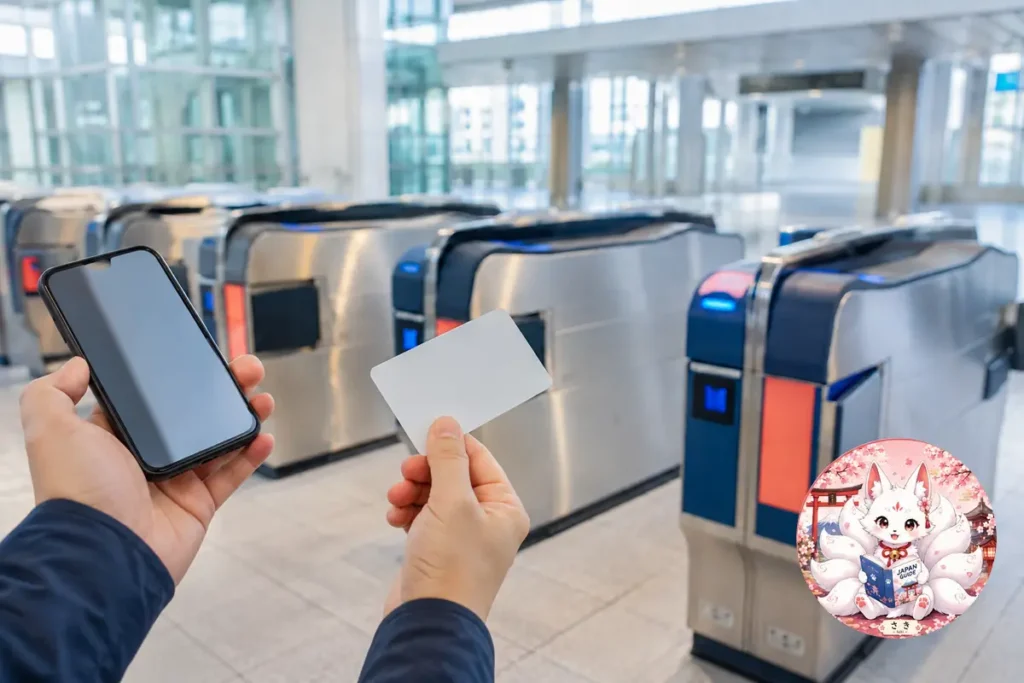
A transportation IC card is one of the easiest ways to pay for local trains, subways, buses, and small purchases in Japan. Instead of buying a paper ticket for every ride, you add money to the card and tap it at the gate.
For most short-term visitors arriving at Narita or Haneda Airport, the practical choice is simple: buy either a Welcome Suica or a TOURIST PASMO at the most convenient counter or machine. They perform the same basic job on participating transportation networks, so you do not need to cross an airport just to get a particular brand.
The details still matter. Both physical visitor cards expire after 28 days and normally do not refund unused stored value. Welcome Suica Mobile has different rules, while regular Suica and PASMO cards may suit longer stays or repeat visits.
This guide compares those options, explains where to buy them, and shows how to avoid the most common mistakes.
Last checked: August 12, 2026. Sales locations, machine availability, and card rules can change, so confirm the linked official pages before your trip.
Quick Answer: Which IC Card Should You Choose?
Buying a physical card at Narita or Haneda?
Choose whichever visitor card is easiest to buy on your route through the airport. Welcome Suica is sold through JR East and Tokyo Monorail locations. TOURIST PASMO is sold through Keisei at Narita and Keikyu at Haneda.
Using a compatible iPhone?
Consider Welcome Suica Mobile if you are at least 13 and have an Apple Pay-compatible device. It remains valid for 180 days after issue, but app availability and top-up functions can be restricted in some countries. Do not depend on it until setup and funding have actually worked.
Staying longer than 28 days or returning to Japan?
A regular Suica or PASMO may be a better fit because it does not have the visitor cards’ fixed 28-day life. Regular physical cards require a ¥500 deposit, and purchase and refund procedures depend on the issuer.
Traveling with a child?
Each child needs a separate child card or child ticket to receive the child fare. Bring the child’s passport or another accepted ID when buying a child IC card. An adult visitor card is not a substitute for a child card.
| Option | Best for | Validity | Deposit | Customer-requested balance refund | Main way to get it |
|---|---|---|---|---|---|
| Welcome Suica (physical) | Short visits; convenient JR East or Tokyo Monorail purchase point | 28 days, including purchase date | None | No | Designated airport machines and JR East locations |
| TOURIST PASMO | Short visits; convenient Keisei or Keikyu purchase point | 28 days from purchase | None | No | Designated Narita and Haneda locations |
| Welcome Suica Mobile | Compatible iPhone users age 13+ | 180 days from issue | None | No | iOS app |
| Regular Suica or PASMO | Longer stays, repeat trips, or travelers prioritizing ordinary refund options | No fixed 28-day tourist expiry; issuer rules apply | ¥500 | Available under issuer conditions | Participating railway machines or counters |
What Is a Transportation IC Card in Japan?
Suica and PASMO are prepaid transportation IC cards. Add yen to the card, touch it to the reader when entering and leaving a participating railway system, and the appropriate basic fare is deducted automatically. On buses, the timing of the taps depends on the operator, so follow the instructions inside the vehicle.
The cards can also work as electronic money at many convenience stores, vending machines, restaurants, and compatible coin lockers. Look for the nationwide mutual-use symbol or an accepted-card logo rather than assuming every terminal accepts your card.
An IC card is not a rail pass. It does not provide unlimited rides or automatically make every trip cheaper. Think of it as a convenient stored-value wallet for basic fares and participating purchases.
Welcome Suica vs TOURIST PASMO
What They Have in Common
The two physical visitor cards are much more alike than different:
- Both are valid for 28 days from the date of purchase.
- Neither requires a ¥500 deposit.
- Unused stored value is not refunded simply because you no longer need the card.
- Both can pay basic fares on participating transportation and can be used at participating merchants.
- Neither can be reissued if it is lost.
- Both come with a reference paper showing information such as the expiration date and adult or child category. Keep it during your trip.
In ordinary use around Tokyo, a Welcome Suica does not become better just because you board a JR train, and a TOURIST PASMO does not become better just because you use a subway. Mutual-use arrangements allow both cards to work across many participating systems.
The Differences That Actually Matter
The useful differences are where the cards are sold, how much stored value is included at purchase, and which operator’s facilities you encounter first.
At Narita Airport, the current official TOURIST PASMO page lists a ¥2,000 product at Keisei information centers. At Haneda Airport, the designated Keikyu machines list ¥1,000, ¥2,000, ¥3,000, ¥4,000, ¥5,000, and ¥10,000 options and accept credit cards for the purchase.
That does not mean credit cards can be used for every later top-up. TOURIST PASMO’s top-up instructions describe cash at supported station machines, while physical Welcome Suica top-ups are also in yen cash. Treat card purchase and card top-up as separate transactions.
Welcome Suica has a broader current list of designated JR East sales locations, including airport stations and several major stations in and around Tokyo. TOURIST PASMO’s visitor product is currently focused on Narita and Haneda Airport sales.
For most short trips, buy the one on your natural route. The printed design is less important than avoiding an unnecessary walk with luggage.
Welcome Suica Mobile for iPhone Users
Welcome Suica Mobile is an iOS app that can issue and top up Suica on an Apple Pay-compatible device. JR East states that users must be at least 13 and that the issued Suica is valid for 180 days.
This is different from the 28-day physical Welcome Suica. It can be convenient if you prefer tapping your phone or Apple Watch and do not want to visit a sales counter.
Check these points before relying on it:
- Some iOS and watchOS versions are not supported.
- App download, issue, and top-up functions may be restricted by law in some countries or regions.
- A payment card stored in Apple Pay is not a guarantee that every top-up attempt will succeed.
- The remaining balance is not refundable and expires at the end of the 180-day validity period.
- Keep another way to pay available in case your phone, payment card, or app is unavailable.
Android support is more complicated because compatibility can depend on the device and where it was sold. For a first-time visitor with an overseas Android phone, a physical visitor card is the safer default unless the device manufacturer and the relevant IC-card service confirm support.
Should You Buy a Regular Suica or PASMO Instead?
A regular physical Suica or PASMO is worth considering if your stay exceeds 28 days, you expect to return to Japan, or you want the ordinary card’s refund route.
Both regular cards include a ¥500 deposit. For a JR East-issued Suica, JR East currently refunds the remaining balance after deducting a ¥220 handling fee, then returns the ¥500 deposit. The card must be returned to the appropriate issuer; for example, JR East warns that cards issued by other companies follow that company’s procedure.
PASMO’s English guidance says the stored balance and ¥500 deposit are refunded when the card is returned, but purchasing and refund procedures can differ by transportation provider. Confirm the current process at the operator that issued your card.
A regular card is not automatically best for every tourist. It adds a deposit, and completing a refund can cost time near the end of a trip. If you are visiting for one or two weeks, adding small amounts to a deposit-free visitor card is often simpler.
Where to Buy at Narita and Haneda Airports
Narita Airport
JR East currently lists Welcome Suica sales at its travel service centers and Welcome Suica ticket vending machines at:
- Narita Airport Terminal 1 Station
- Narita Airport Terminal 2・3 Station
Terminal 3 does not have a separate rail station. Travelers using Terminal 3 follow signs toward the station serving Terminals 2 and 3.
Keisei currently lists TOURIST PASMO sales at the SKYLINER & KEISEI INFORMATION CENTER at its Terminal 1 Station and Terminal 2 Station. The listed TOURIST PASMO amount at Narita is ¥2,000.
JR East and Keisei use slightly different English styling for the airport station headings. Follow the railway company signs as well as the terminal number, especially where the JR and Keisei facilities are close together.
After buying the card, choose the airport service that fits your hotel. Our guide to getting from Narita Airport to Tokyo compares the Skyliner, Narita Express, Access Express, buses, and private transfers by destination area.
Haneda Airport
JR East currently lists Welcome Suica sales at Haneda Airport Terminal 3 (Tokyo Monorail) Station through the JR EAST Travel Service Center and designated vending machines.
TOURIST PASMO is sold by Keikyu at:
- Haneda Airport Terminal 1・2 Station: designated traveler ticket machines near the Terminal 1 and Terminal 2 gates
- Haneda Airport Terminal 3 Station: the Keikyu Tourist Information Center and a designated traveler ticket machine next to it
The Keikyu station and the Tokyo Monorail station at Terminal 3 are separate facilities. Choose the operator you plan to use instead of searching for a generic “Haneda station.”
If You Do Not Buy One at the Airport
JR East’s current Welcome Suica purchase page lists travel service centers at Tokyo, Shibuya, Shinjuku, Ikebukuro, Ueno, Yokohama, and Sendai stations, along with other designated locations. Some locations can temporarily stop sales, so check the live list rather than relying on an old map.
Regular Suica and PASMO cards may be sold at participating machines or counters. Availability and procedures depend on the operator and machine, so use the on-screen options and current station guidance.
How to Use and Top Up an IC Card
For a typical train or subway ride:
- Touch the card or device to the reader at the entrance gate.
- Keep using that same card or device throughout the trip.
- Touch it again at the exit gate.
- If the balance is insufficient, use an appropriate fare-adjustment machine or ask station staff.
Do not enter with a physical card and try to exit with your phone. The system needs the same identifier to complete the trip. One card also cannot carry two people through the gate at the same time; each traveler needs a separate card or ticket.
For physical Welcome Suica, JR East says top-ups use yen cash. Supported ticket machines, fare-adjustment machines, Seven Bank ATMs, and participating convenience stores can provide top-up options. TOURIST PASMO can also be topped up with cash at supported station machines and at participating stores.
Machine and store procedures vary. Check the screen before inserting cash, and do not assume a machine that sells a card supports the same payment methods for top-up. If you need yen, see our guide to withdrawing Japanese yen from an ATM.
Where You Can and Cannot Use It
Trains, Subways, Buses, and Shopping
Suica and PASMO participate in Japan’s nationwide IC-card mutual-use network. On participating systems, the same card can work well beyond Tokyo, including parts of the Kansai region around Osaka and Kyoto.
However, “nationwide” does not mean every railway, bus, or store. Some local networks do not accept these cards, and some shops inside otherwise compatible areas use different payment systems.
You also cannot assume that you can remain inside the gates while traveling continuously from one separate IC-card area into another. If a journey crosses area boundaries, buy the appropriate ticket in advance or ask staff before entering.
Shinkansen, Limited Express, and Airport Trains
Stored value on an IC card usually covers the basic-fare portion of an eligible local trip. It does not automatically include every additional charge.
Limited express, express, Green Car, reserved-seat, and Shinkansen travel may require another ticket or a separate reservation service. For example, the Keisei Skyliner requires a Skyliner ticket in addition to the basic fare, and the Narita Express requires the appropriate limited express ticket.
Some reservation systems let you link an IC card and tap through the gate after buying the required ticket online. That is a separate setup—not proof that the IC balance alone paid for the train.
Coin Lockers and Shops
At a compatible coin locker, an IC card or phone may be both the payment method and the key. Keep that exact card or device until you retrieve the bag. Procedures vary by locker model, and partial payment with cash may not be available.
If lockers are full or you need another option before hotel check-in, compare luggage storage in Tokyo, including staffed counters, app-booked storage, and luggage delivery.
How Much Should You Load?
Avoid loading a large amount just because the machine offers it. The right balance depends on your route, trip length, and whether you plan to use the card for shopping.
For a short Tokyo stay, ¥2,000–¥3,000 can be a reasonable starting balance, not a complete-trip budget. Check the balance after a few rides and add more in small steps. Airport travel and long day trips can use more than ordinary central-Tokyo journeys.
This cautious approach matters most with Welcome Suica and TOURIST PASMO because customer-requested refunds of unused stored value are not available. Near the end of the trip, use the remaining balance at participating shops or vending machines when practical. Ask before attempting to split a purchase between the IC balance and another payment method because the rules differ by merchant and terminal.
Common Mistakes to Avoid
- Looking for PASMO PASSPORT. Its rules were abolished in 2024. TOURIST PASMO is the current visitor product shown on PASMO’s official site.
- Counting 28 days from the end of the trip. The clock starts on the purchase date.
- Using the GOOD THRU printing as the expiration date. For physical Welcome Suica, the actual validity is on the reference paper.
- Throwing away the reference paper. Keep it with your travel documents during the card’s valid period.
- Assuming the IC balance pays every train charge. Special trains and reserved services can require another ticket.
- Entering and exiting with different cards or devices. Use the same medium for the entire trip.
- Loading too much at once. Add money in smaller amounts when the balance is non-refundable.
- Assuming mobile setup will work after landing. Test app availability, device support, and funding before making it your only plan.
- Assuming every route accepts the card. Check the mutual-use symbol and the operator’s current instructions.
Final Recommendation
For most visitors staying 28 days or less, there is no major practical winner between physical Welcome Suica and TOURIST PASMO. Buy the one that is easiest to obtain at your terminal or along your first train route.
Choose Welcome Suica Mobile when you are 13 or older, have a compatible iPhone or Apple Watch, and have confirmed that issue and top-up work for you. Choose a regular Suica or PASMO when the 28-day limit is too short, you expect to reuse the card, or the ordinary refund route is important enough to justify the deposit and return procedure.
The brand name matters less than four questions: Where can you get it? How long will it remain valid? Can you recover unused value? Does your device support the mobile option? Answer those, and the choice becomes straightforward.
Frequently Asked Questions
Is Suica better than PASMO in Tokyo?
Not for most ordinary trips. Both work across many participating JR, subway, private railway, and bus systems through mutual-use arrangements. For tourists, the more important differences are the product’s validity, refund rules, sales location, and mobile compatibility.
Can I use Welcome Suica in Kyoto or Osaka?
You can use it on participating transportation and at participating merchants displaying the compatible nationwide IC-card symbol. It is not accepted everywhere, and continuous travel between separate IC-card areas can be restricted.
Can I use an IC card on the Shinkansen?
Do not expect stored value alone to cover a Shinkansen trip. Some booking services allow a registered IC card to act as the gate credential after you purchase the required Shinkansen ticket. The booking and the IC balance are separate parts of the process.
Can two people share one IC card?
Not for simultaneous travel through automatic gates. Each traveler needs a separate card or ticket so the system can record that person’s entry and exit.
Can I top up with a foreign credit card?
Physical Welcome Suica top-ups use yen cash. TOURIST PASMO’s specified Haneda machines accept credit cards for the initial purchase, but its general top-up instructions use cash. Welcome Suica Mobile can use a card registered with Apple Pay, but compatibility and availability can vary; confirm that your own top-up succeeds.
What happened to PASMO PASSPORT?
PASMO lists an abolition notice for the PASMO PASSPORT rules dated October 4, 2024. TOURIST PASMO is the current international-visitor product shown on PASMO’s official site in 2026.
Do children need their own card?
Yes, if they will use an IC card for child fares. Bring the child’s passport or another accepted proof of age. The child product has age-related rules in addition to any visitor-card expiration date.
What happens to unused balance?
Unused value on Welcome Suica and TOURIST PASMO is not refunded for ordinary customer reasons. Welcome Suica Mobile balance also expires without a refund at the end of its 180-day validity. Regular cards have issuer-specific refund procedures and may involve a handling fee.
For a real-world IC-card trip example, see our guide to getting to Tokyo Big Sight by the Rinkai Line or Yurikamome.