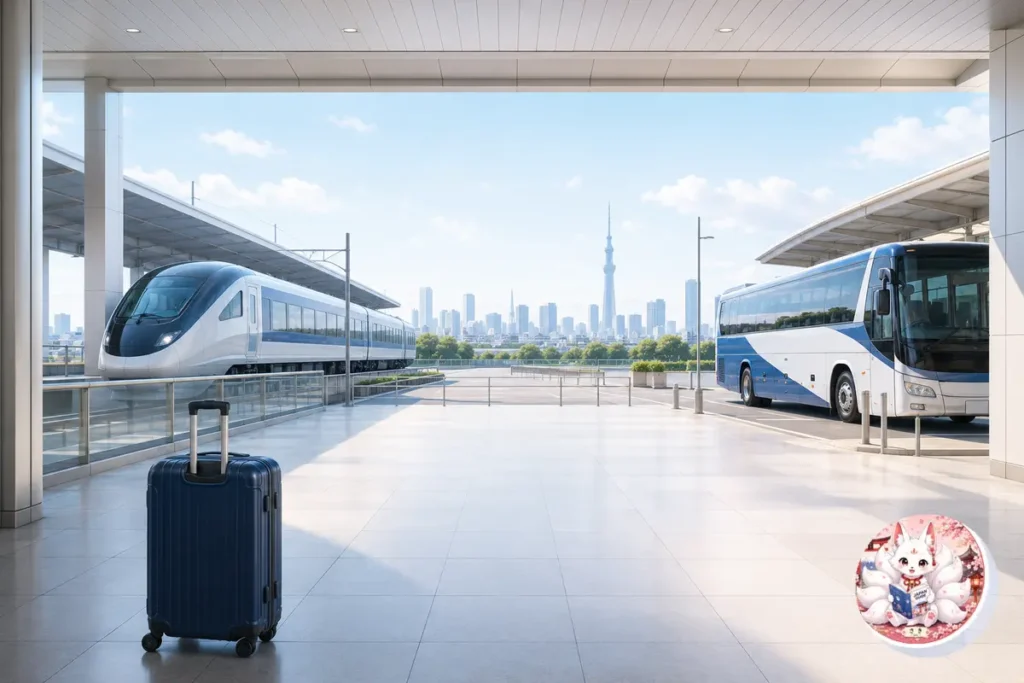
Narita International Airport is in Chiba Prefecture, well outside central Tokyo. After a long flight, the number of train and bus choices can make the trip to your hotel look more complicated than it is.
There is no single best way to travel from Narita Airport to Tokyo. The right option depends first on your hotel’s nearest station—not simply whether its address says “Tokyo.” The Keisei Skyliner is especially convenient for Ueno and Nippori, while the Narita Express can reduce transfers to Tokyo, Shinagawa, Shibuya, and Shinjuku. Buses may be easier when their stop is close to your hotel, and a private transfer may make sense for a family or group with several suitcases.
This guide compares the main options by destination, fare, travel time, luggage, and convenience. Fares, timetables, and stops can change, so check the operator’s current information for your travel date before buying a ticket.
Disclosure: This article contains affiliate links. If you book through them, I may earn a commission at no extra cost to you.
Quick Answer: Choose by Your Tokyo Destination
| Your destination | Best place to start | Why | Check before choosing |
|---|---|---|---|
| Ueno or Nippori | Keisei Skyliner | Fast, reserved seats, luggage space | Keisei-Ueno and JR Ueno are separate stations |
| Tokyo Station or Marunouchi | Narita Express or TYO-NRT | Choose direct rail or a lower-cost bus | The bus is affected by road traffic |
| Ginza | TYO-NRT, Access Express, or Limousine Bus | The best choice depends on the exact stop and hotel location | Check the walk after getting off |
| Shinjuku or Shibuya | Narita Express | Direct service can avoid a transfer | Confirm your train’s stops and departure time |
| Asakusa or Nihombashi | Access Express | Some trains provide a useful through service | Check the train type and destination display |
| Shinagawa | Narita Express or Access Express | Both can work without changing trains on suitable services | Not every departure follows the same pattern |
| A hotel served by Limousine Bus | Airport Limousine Bus | Less walking with heavy luggage | Not every hotel has a stop |
| Family, group, or several large bags | Private transfer | Door-to-door travel | Compare the total vehicle price and luggage capacity |
Tokyo Station is one specific station. It is not a universal drop-off point for every hotel in Tokyo. Before choosing, open your hotel on a map and confirm its nearest station, exit, and walking route.
Compare the Main Options
| Option | Main destinations | Typical adult fare | Fastest advertised time | Seat and luggage setup | Best for |
|---|---|---|---|---|---|
| Keisei Skyliner | Nippori, Keisei-Ueno | About ¥2,570–¥2,580 | 36 min to Nippori | Reserved seat; dedicated luggage area | Ueno and Nippori |
| Narita Express | Tokyo, Shinagawa, Shibuya, Shinjuku | ¥3,140–¥3,330 | 53 min to Tokyo Station | Reserved seat; large-luggage space | Direct JR access |
| Access Express | Asakusa, Nihombashi, Shimbashi, Shinagawa on suitable trains | About ¥1,290–¥1,520 | Varies by train and destination | Commuter-style seating; no reserved seat | Lower-cost through service |
| Keisei Main Line | Nippori, Keisei-Ueno | About ¥1,030 | Slower than Skyliner | Commuter-style seating | Lowest rail fare toward Ueno |
| AIRPORT BUS TYO-NRT | Tokyo Station, with some services involving Ginza/Shinonome | ¥1,500 ordinary service | 65 min to Tokyo Station | Seated bus; one-suitcase rule | Low-cost ride to Tokyo Station |
| Airport Limousine Bus | Major districts, hotels, and facilities | Route-specific | Road conditions apply | Seated bus; luggage in hold | A stop close to your hotel |
| Private transfer | Your specified destination | Vehicle- and date-specific | Road conditions apply | Private vehicle; capacity varies | Families, groups, multiple bags |
| Fixed-fare airport taxi | Tokyo zones | From ¥29,000 for central zones, plus tolls | Road conditions apply | Private vehicle | Immediate door-to-door travel |
The times above are airport-to-station figures, not guaranteed times to your hotel. Add the wait for the next departure, any transfer, the walk through the station, and the final walk or taxi ride.
Keisei Skyliner: Best for Ueno and Nippori
The Keisei Skyliner is the clearest first choice when your hotel is near Nippori or Ueno. Keisei advertises a fastest travel time of 36 minutes to Nippori, and the train continues to Keisei-Ueno.
All seats are reserved, and each car has a dedicated luggage area. This makes the Skyliner easier to use with a suitcase than an ordinary commuter train. Nippori also offers a convenient transfer to JR lines, including the Yamanote Line.
The important limitation is its destination. The Skyliner does not run directly to Tokyo Station, Shibuya, or Shinjuku. If your hotel is elsewhere, compare the full route after Nippori or Keisei-Ueno rather than choosing only because the airport segment is fast.
Keisei-Ueno Station is also separate from JR Ueno Station. The walk may be manageable for some hotels, but it is not the same as arriving inside the JR station. For Asakusa, check whether an Access Express train or another route is more convenient than taking the Skyliner and then making an additional journey from Ueno.
As of August 12, 2026, the normal adult total between the airport and Nippori or Keisei-Ueno is approximately ¥2,570 with an eligible IC card or ¥2,580 with magnetic tickets. Check the official Keisei fare and ticket information before travel.
If you buy through a third party, read the redemption instructions. A voucher or QR code may still need to be exchanged or used to select a departure and reserved seat before boarding.
Narita Express: Best for Direct JR Access
The JR East Narita Express, usually written as N’EX, is often the simplest train when your destination is Tokyo Station, Shinagawa, Shibuya, or Shinjuku. Its advantage is not that it wins every speed comparison. Its advantage is that a direct train to a major JR station can remove a transfer while you are carrying luggage.
The fastest advertised trip to Tokyo Station is 53 minutes. Current ordinary-car one-way fares from the airport are ¥3,140 to Tokyo Station and ¥3,330 to Shinagawa, Shibuya, or Shinjuku. All seats are reserved.
N’EX trains have overhead racks and dedicated large-luggage spaces. JR East says these spaces do not require a separate luggage reservation, but they are first-come, first-served. Depending on the size of your bag and how full the train is, you may need to keep luggage at your feet.
Do not assume every N’EX departure stops at every station shown on a general route map. Check the specific train for your date and time. JR East’s current N’EX page lists the service area and links to timetables.
JR East also sells the N’EX TOKYO Round Trip Ticket for eligible travelers. It currently costs ¥5,200 and is valid for a round trip within 14 days. That is a different product from a normal one-way ticket, so check eligibility, the covered area, validity, and seat-reservation procedure before purchasing.
If you only need a one-way ride, compare the normal JR fare rather than buying a round-trip product automatically.
Access Express and Keisei Main Line: Lower-Cost Train Options
Keisei’s Access Express can be a useful lower-cost option for Asakusa, Nihombashi, Shimbashi, or Shinagawa when the train’s route matches your destination. Current ordinary fares from the airport are about ¥1,290 to Asakusa, ¥1,330 to Nihombashi or Shimbashi, and ¥1,520 to Shinagawa; eligible IC-card fares are slightly lower.
However, “Access Express” does not mean that every train runs directly to all of those stations. Some services head toward the Toei Asakusa Line and Keikyu Line, while others run toward Nippori and Keisei-Ueno. Read the train type, destination, and departure information before boarding. If you are uncertain, show the station name to staff and ask whether that specific train goes there without a change.
Access Express trains are commuter-style trains. Do not expect an assigned seat or the same dedicated luggage arrangement as the Skyliner. They can be a good balance of fare and convenience outside busy periods, but standing with a large suitcase during a crowded journey may be uncomfortable.
The Keisei Main Line rapid limited express or limited express is another budget option toward Nippori and Keisei-Ueno. The current adult fare is about ¥1,030. It uses the slower Main Line route with more stops than the Skyliner, and seating is not reserved.
For both services, compare the savings with your arrival time, luggage, and final transfer. The lowest airport fare is not necessarily the easiest hotel route.
Airport Buses: Best When the Stop Fits Your Hotel
An airport bus can reduce escalators, station corridors, and transfers. It works best when the arrival stop is genuinely close to your hotel—not merely in the same large district.
AIRPORT BUS TYO-NRT
AIRPORT BUS TYO-NRT is a low-cost bus between Narita Airport and the Tokyo Station side of central Tokyo. The ordinary adult one-way fare is currently ¥1,500. The operator advertises a fastest journey of 65 minutes between the airport and Tokyo Station, but road conditions can make the trip longer.
Some timetable patterns and stops involve Ginza or Shinonome, but do not assume every bus serves every stop. Check the direction, date, boarding point, and current timetable on the official TYO-NRT website.
The operator currently limits each passenger to one suitcase with total dimensions of approximately 158 cm or less. Bicycles, skis, snowboards, surfboards, golf bags, large instruments, cardboard boxes, and extra luggage are among the items it says cannot be placed in the trunk or bus. If you have special or multiple large items, read the official baggage rules before relying on this service.
Early-morning or late-night services, where operated, cost ¥3,000 rather than the ordinary ¥1,500 fare. Do not plan around a late service until you have confirmed it for your travel date.
Airport Limousine Bus
The Airport Limousine Bus serves major districts, hotels, and facilities. For a first-time visitor with a large suitcase, a stop at or near the accommodation can be worth paying more than the cheapest train fare.
Service is not available to every hotel, and routes change. Search for your exact stop and date instead of assuming that “Shinjuku,” “Ginza,” or “Odaiba” guarantees a convenient drop-off.
The general checked-baggage rule currently allows up to two pieces per person, each no larger than 50 × 60 × 120 cm and no heavier than 30 kg. Jointly operated routes may handle baggage differently, and the operator can refuse items that would interfere with service. Keep your passport, cash, electronics, and other valuables with you. See the official baggage guidance for exclusions.
Before booking, compare the Klook option with the operator’s live timetable and confirm that the chosen package covers your exact stop and direction.
Private Transfer or Taxi: When Door-to-Door Is Worth It
Private transfer
A prebooked private transfer can be practical for a family, a group of three or four, travelers with several suitcases, or anyone who wants to avoid carrying bags through large stations. Compare the vehicle total—not only a headline per-person price—with the total train or bus cost for everyone.
Before paying, check:
- The meeting point in your arrival terminal
- How long the driver waits after the scheduled pickup time
- What happens if your flight is delayed
- Whether tolls, parking, and late-night charges are included
- The maximum number of passengers and suitcases for the selected
vehicle - Whether child seats must be requested and paid for separately
- The cancellation deadline and contact method
Do not choose a vehicle using passenger capacity alone. Four passengers with four large suitcases may require a larger vehicle than four passengers with small bags.
Prices and terms change after you enter the travel date, pickup time, destination, passenger count, and luggage. Treat the final checkout page—not a general “from” price—as the actual offer.
Fixed-fare airport taxi
Narita Airport also has fixed-fare taxis to zones in Tokyo. They do not require advance reservations, but the airport instructs passengers to ask the driver about the fixed fare before hiring the taxi.
Current fixed fares for central zones start at ¥29,000, and some routes or zones cost more. Expressway tolls and other actual charges are additional. A late-night or early-morning surcharge applies from 10:00 p.m. to 5:00 a.m. The airport’s official taxi page lists the zones and current fares.
This is usually too expensive to be the standard recommendation for one or two travelers. It can still be useful when you need an immediate door-to-door ride and accept the cost.
Which Option Is Best for Your Hotel Area?
If you have not chosen a hotel yet, first compare the practical strengths of seven popular Tokyo areas for first-time visitors. Airport access matters, but it should not be the only reason you choose where to stay.
Shinjuku and Shibuya
Start with the Narita Express because a direct ride can remove a transfer. Then compare the current Airport Limousine Bus stops. A bus stop close to your hotel may be easier with heavy luggage, but “Shinjuku” covers a large area, and the final walk matters.
Ueno and Asakusa
For Ueno, start with the Skyliner. Confirm whether your hotel is closer to Keisei-Ueno, JR Ueno, or another subway station.
For Asakusa, compare a suitable Access Express through service with the Skyliner plus an additional trip from Ueno. Ueno and Asakusa are neighboring sightseeing areas, but they are not interchangeable transport destinations.
Tokyo Station and Ginza
For Tokyo Station or Marunouchi, compare the direct Narita Express with the lower-cost TYO-NRT bus. For Ginza, also check Access Express service to Higashi-Ginza and the current bus stops.
Tokyo Station is enormous. Check whether your hotel is on the Marunouchi or Yaesu side and how far the bus stop or N’EX platform is from your exit.
Shinagawa
Both N’EX and suitable Access Express trains can reach Shinagawa without a change. Compare the actual departure available after your flight. Shinagawa is also useful for the Tokaido Shinkansen, but allow time to move between platforms.
Odaiba
Odaiba does not have a universal direct airport option at every time. Check whether an Airport Limousine Bus serves your exact hotel or nearby stop on your date. If not, compare a route through central Tokyo with a private transfer. Do not treat “Tokyo Bay” as one compact location.
What to Do After You Land
- Finish immigration and baggage claim, then confirm your
terminal. - If you arrive at Terminal 3 and plan to take a train, follow signs
to Narita Airport Terminal 2・3 Station; the airport estimates about a
10-minute walk. - Open your hotel booking and confirm the nearest station, exit, and
check-in time. - Check the operator’s live timetable and service notices for that
day. - Buy the ticket or complete any voucher exchange and seat selection
required. - If you have several bags, favor fewer transfers over a small fare
difference.
Mobile data makes it easier to check live service information and contact your hotel. If you still need connectivity, compare the options in the Japan eSIM guide.
If you will arrive before check-in, ask your hotel whether it can hold your bags. Otherwise, the guide to luggage storage in Tokyo before check-in compares hotel storage, lockers, reserved storage, and delivery.
Common Mistakes to Avoid
- Confusing Tokyo Station with Tokyo as a whole
- Assuming the Skyliner runs directly to Tokyo Station, Shibuya, or
Shinjuku - Treating Keisei-Ueno and JR Ueno as the same station
- Choosing the fastest airport segment without counting the final
transfer and walk - Boarding an Access Express without checking its destination
- Assuming every N’EX train stops at every major station
- Assuming a Limousine Bus stops at your hotel because it serves the
same district - Treating a road-transport time as guaranteed
- Ignoring baggage quantity, size, or weight limits
- Assuming a late-night arrival still has a convenient train or
bus - Assuming an online voucher already includes any required ticket
exchange or seat selection
Final Recommendation
Choose from your hotel backward.
- Ueno or Nippori: start with the Skyliner.
- Tokyo Station, Shinagawa, Shibuya, or Shinjuku: start with the
Narita Express. - Asakusa, Nihombashi, Shimbashi, or Shinagawa on a suitable
departure: compare Access Express. - Tokyo Station on a tighter budget: check TYO-NRT.
- A hotel with a convenient bus stop: compare Airport Limousine
Bus. - A family or group with several bags: price a private transfer by
vehicle.
Before buying, check the exact departure, destination, stop, fare, and baggage conditions for your travel date. The easiest airport ride is the one that gets you closest to your actual hotel with a transfer and luggage plan you can manage.