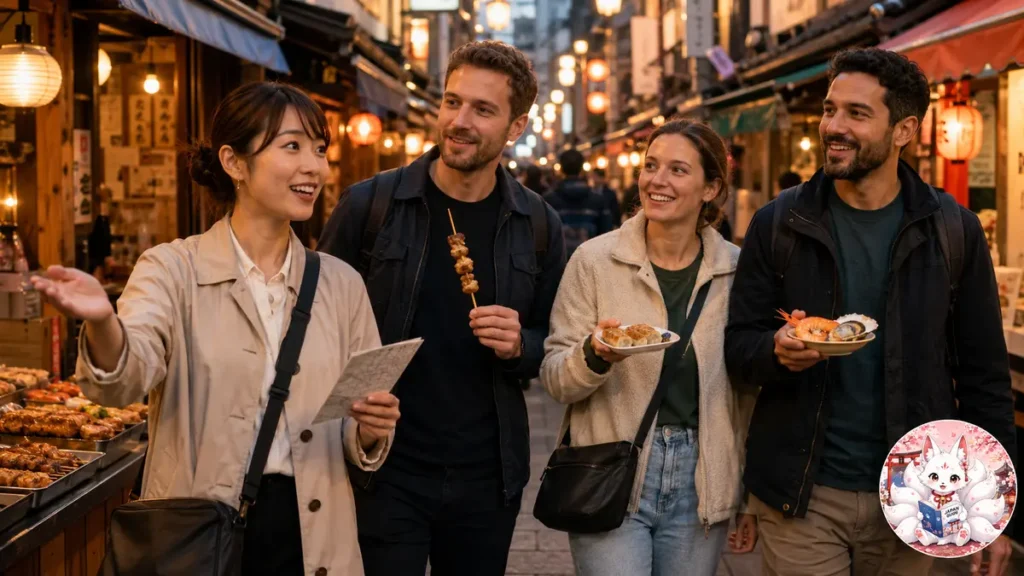
Tokyo is easy to eat your way through once you know where to go. The harder part for many first-time visitors is stepping into a tiny izakaya, understanding what is included, and ordering confidently when the menu and staff use little English.
An English-guided food tour removes much of that uncertainty. A local guide leads you between restaurants, orders or explains the food, and provides context that you would not get from choosing a restaurant alone.
However, tours with similar names can deliver very different experiences. Some provide a full meal across several restaurants. Others focus more heavily on sake, nightlife, conversation, or a walk through a market where you may need to pay for additional food yourself.
For most first-time visitors, the Shinjuku Food Tour with 15 Dishes and 4 Local Eateries is our top pick. It combines a substantial amount of food, four stops, an English-speaking guide, a central location, and a much deeper review history than most of the direct alternatives in this comparison.
That does not make it the right choice for everyone. The two-hour Tsukiji tour is shorter and much less expensive, the Asakusa daytime tour is designed around families, and the two Shinjuku bar tours are better for travelers who care more about Tokyo nightlife than the widest possible food selection.
What we compare: Not just the neighborhood and advertised price, but how much food is described, whether drinks are central to the experience, who can book, and what you need to verify before paying.
Affiliate disclosure: This article contains affiliate links. If you book through them, we may earn a commission at no extra cost to you.
The Short Answer: Best Tokyo Food Tour for Each Type of Traveler
- Best overall for first-time visitors: Shinjuku Food Tour with 15 Dishes and 4 Local Eateries
- Best short, low-cost introduction: Tsukiji Fish Market Food and Walking Tour
- Best traditional evening atmosphere: Asakusa Guided Food Tour with 12 Dishes
- Best for combining food with Shibuya sightseeing: Shibuya Food Tour with 13 Dishes
- Best lower-priced nightlife experience: Shinjuku Local Bar & Izakaya Crawl
- Best all-inclusive bar-hopping option: Shinjuku Bar Hopping with Free-Flow Drinks and Full Dinner
- Best daytime option for families: Asakusa Family Food Tour
Quick Comparison of 7 English-Guided Tokyo Food Tours
| Tour | Best for | Area | Duration | Main experience | Starting price | Check before booking |
|---|---|---|---|---|---|---|
| Shinjuku Food Tour with 15 Dishes | First-time Tokyo visitors | Shinjuku | 3 hr | About 15 dishes at four eateries | From ¥12,550 (about US$78) | Dietary requests and stair access |
| Tsukiji Fish Market Food and Walking Tour | Shorter, lower-cost tour | Tsukiji | 2 hr | Market walk and food sampling | From ¥2,160 (about US$13) | Exactly which tastings are included |
| Asakusa Guided Food Tour with 12 Dishes | Traditional evening and sake | Asakusa | 2.5 hr | Twelve dishes, local restaurants, and sake bars | From ¥12,590 (about US$79) | Alcohol focus and cash for extras |
| Shibuya Food Tour with 13 Dishes | Food plus Shibuya nightlife | Shibuya | 3 hr | Thirteen dishes at three eateries | From ¥13,940 (about US$87) | Smaller review base and value for money |
| Shinjuku Local Bar & Izakaya Crawl | Social, lower-priced nightlife | Shinjuku | 3 hr | Izakaya, bars, sake, and possible karaoke | From ¥6,020 (about US$38) | Included food and drinks may vary |
| Shinjuku Bar Hopping with Full Dinner | All-inclusive nightlife | Shinjuku | 3 hr | Three bars, dinner, and free-flow drinks | From ¥16,960 (about US$106) | Age 20+ and minimum two participants |
| Asakusa Family Food Tour | Families and daytime sightseeing | Asakusa | 3 hr | Regional lunch, snacks, sweets, tea, and local history | Check live price | Available dates and current package price |
Prices were checked on Klook’s US-facing pages on August 18, 2026. Japanese yen amounts use an approximate exchange rate of ¥160 to US$1. Prices, exchange rates, discounts, itineraries, and availability change, so check the live booking page before paying.
How We Chose These Tours
We limited this comparison to guided eating tours. Sushi-making, ramen-making, bento classes, single-restaurant vouchers, and stand-alone sake tastings are outside the scope of this article.
For a first-time English-speaking visitor, we considered:
- Whether an English-speaking guide is clearly listed
- How many restaurants, dishes, or tastings are described
- Whether the experience appears to provide a full meal or lighter samples
- Whether alcohol is optional, included, or central to the tour
- Daytime versus evening scheduling
- Solo, couple, family, and age-related booking conditions
- Dietary, allergy, mobility, and accessibility information
- The clarity of the meeting point and tour duration
- Booking and review volume, without treating star ratings as absolute rankings
- Whether the price appears reasonable for what the listing clearly includes
We have not called every high-rated tour “the best.” A perfect score based on a small number of reviews does not provide the same evidence as a slightly lower score supported by hundreds of participants.
The restaurants themselves are also not necessarily English-speaking. “English-guided” means the tour guide conducts the experience in English and helps guests navigate the stops. Routes, restaurants, dishes, and portions may change with availability.
Shinjuku Food Tour with 15 Dishes: Best Overall for First-Time Visitors
For travelers who want a broad introduction to Japanese food without building an entire evening around alcohol, this is our top pick.
The three-hour group tour advertises approximately 15 dishes across four local eateries in Shinjuku. The listing mentions foods such as sashimi, tonkatsu, gyoza, street food, and Japanese sake, although the actual selection can change. It combines seated stops with food sampled while exploring the neighborhood.
Klook showed a 4.9 rating from 244 reviews and more than 3,000 bookings when checked. That is not proof that every departure will be identical, but it gives first-time visitors substantially more feedback to evaluate than several newer alternatives.
Shinjuku is another advantage. Many visitors already plan to see Kabukicho, Golden Gai, Omoide Yokocho, or the station area. Taking the tour early in your trip can also make smaller restaurants feel less intimidating later, because you see how a guide approaches ordering and local dining customs.
The listing asks guests to report allergies and dietary restrictions in advance. Some venues may be in basements or on upper floors without elevators, so travelers who cannot use stairs should contact the operator before booking.
Best fit: First-time visitors, couples, solo travelers, and anyone who wants a food-first evening with a large variety of dishes.
Consider another tour if: You want a daytime family activity, a dedicated market walk, or an alcohol-centered night out.
Check before booking: The current food list, dietary accommodations, meeting time, and whether all planned venues are accessible to you.
Tsukiji Fish Market Food and Walking Tour: Best Short, Low-Cost Introduction
This two-hour tour is the shortest option in our main comparison and was also by far the least expensive when checked.
The route begins around Tsukiji Hongwanji and continues into Tsukiji Outer Market with an English-speaking guide. The description emphasizes market history, Japanese culinary traditions, and samples of food or ingredients. Klook showed a 4.9 rating from 320 reviews and more than 3,000 bookings.
The unusually low displayed price is the main reason to read the package details carefully. A listing may use the phrase “food tour” while including only limited samples, leaving additional sushi, seafood, wagyu, drinks, or snacks to be purchased separately. Do not compare the headline price directly with a tour that explicitly includes 12 or 15 dishes.
This tour can work well for visitors who primarily want an English introduction to the market and the confidence to continue exploring independently afterward. It also fits more easily into a morning than a three-hour multi-restaurant meal.
For opening-hour strategy, access, crowd behavior, and what to buy independently, read the Life with Saki guide to Tsukiji Outer Market.
Best fit: Budget-conscious visitors, travelers with limited time, and anyone who wants a guided introduction before buying additional food independently.
Consider another tour if: You want a clearly described full meal included in the price.
Check before booking: The exact included tastings, whether food purchases are extra, the meeting point, and the current market itinerary.
Asakusa Guided Food Tour with 12 Dishes: Best Traditional Evening Atmosphere
This two-and-a-half-hour Asakusa tour combines local restaurants, sake bars, Hoppy Street, and approximately 12 Japanese dishes.
The listing describes an English-only tour rather than a bilingual departure. It includes an izakaya, sake from different regions, a sweet fish-shaped waffle for dessert, and time walking through one of Tokyo’s most recognizable traditional districts. When checked, Klook showed a 5.0 rating from 30 reviews and more than 200 bookings.
Although Asakusa is famous for Senso-ji and daytime sightseeing, this itinerary focuses on the area after the main temple visit. It may suit travelers who want a more social evening without going directly into Shinjuku’s busiest nightlife streets.
Alcohol is an important part of the advertised experience. The listing says additional food and drinks should be paid for in cash. Travelers who do not drink should confirm what nonalcoholic alternatives are available and whether the tour still represents good value for them.
The operator also asks guests to report wheelchair requirements in advance so restaurant arrangements can be adjusted.
Best fit: Adults interested in izakaya culture, sake, and an evening in traditional Asakusa.
Consider another tour if: You want a daytime family tour or a food-focused experience with less emphasis on drinking.
Check before booking: Included drinks, nonalcoholic alternatives, age restrictions, wheelchair arrangements, and cash needed for extras.
Shibuya Food Tour with 13 Dishes: Best for Combining Food With Shibuya Sightseeing
This three-hour tour takes place around Shibuya and advertises 13 dishes across three eateries.
The main appeal is location. If Shibuya Crossing, Center-gai, or the surrounding nightlife is already part of your itinerary, the tour lets you combine a central sightseeing stop with dinner and local guidance. The listing describes hidden dining spots, Japanese comfort food, and cultural background from an English-speaking guide.
At the time of checking, Klook showed a 4.6 rating from 17 reviews and more than 200 bookings. That is a much smaller evidence base than the Shinjuku top pick. One published review also questioned the value of the food relative to the price, while others praised the guide and selection.
This does not make the tour a poor choice. It means the Shibuya location should be an important reason for booking it. If location does not matter, the Shinjuku tour currently has more reviews, more bookings, and a slightly lower displayed starting price.
Best fit: Travelers who want dinner and an introduction to Shibuya’s evening atmosphere in one activity.
Consider another tour if: You prioritize review depth, the lowest price, or the largest number of clearly described stops.
Check before booking: The current restaurants, included drinks, dietary options, and whether the price is competitive on your date.
Shinjuku Local Bar & Izakaya Crawl: Best Lower-Priced Nightlife Experience
This is closer to a social nightlife crawl than a structured multi-course food tour.
Over approximately three hours, the guide takes the group through places such as Omoide Yokocho, Kabukicho, and Golden Gai. Depending on the departure, the experience may include an izakaya, sake tasting, small bars, and karaoke. The listing describes English and Japanese guidance.
Klook showed a 4.9 rating from 756 reviews and more than 6,000 bookings, giving it the largest participation history in this comparison. The displayed price was also much lower than the full-dinner bar tour.
The tradeoff is that the booking page is less precise about a fixed amount of food and drink. Reviews describe different group sizes and combinations of izakaya food, drinks, sake, and karaoke. Treat the itinerary as a guided social night rather than a promise of a particular dinner menu.
This may be especially helpful for a solo traveler who would not enter a tiny Golden Gai bar alone. However, a traveler mainly interested in food quantity may prefer the 15-dish Shinjuku tour.
Best fit: Social travelers, solo visitors, and adults who want help entering small Shinjuku bars at a comparatively low starting price.
Consider another tour if: You need a clearly specified full dinner, a small guaranteed group, or a food-first experience.
Check before booking: What food and drinks are included, the expected group size, the final stop, and your last-train plan.
Shinjuku Bar Hopping with Full Dinner: Best All-Inclusive Nightlife Option
This three-hour Shinjuku bar-hopping tour costs more, but the inclusion is easier to understand: the listing advertises food, dinner, and drinks, including an all-you-can-drink izakaya stop.
The route covers well-known nightlife areas such as Omoide Yokocho, Kabukicho, and Golden Gai. Foods may include yakitori, gyoza, grilled vegetables, and other izakaya dishes, accompanied by beer or sake. The English-speaking guide handles the sequence of three bars.
Klook showed a 4.8 rating from 98 reviews and more than 1,000 bookings when checked. The product page also states that participants must be at least 20 years old, Japan’s legal drinking age.
The booking package required at least two participants when we checked it. That makes the tour less suitable for a solo traveler even though the experience itself is designed for small social groups.
The higher price may still be worthwhile for travelers who prefer knowing that dinner and drinks are built into the booking instead of calculating separate payments at each stop.
Best fit: Couples and groups age 20 or older who want a structured, all-inclusive Shinjuku night.
Consider another tour if: You are traveling alone, do not drink, or want food variety rather than bar access.
Check before booking: Minimum booking size, included drink limits, dietary requests, cancellation terms, and the end time.
Asakusa Family Food Tour: Best Daytime Option for Families
The Asakusa Family Food Tour is the clearest alternative to the evening and alcohol-heavy options in this comparison.
The three-hour English-guided itinerary is built around daytime sightseeing, local history, a regional Japanese lunch, and smaller tastes such as pickles, rice crackers, tea, traditional sweets, and melon bread. The advertised foods can change with the season.
Because the tour takes place around Kaminarimon, Nakamise, and Asakusa’s side streets, families can combine it with Senso-ji without crossing Tokyo for a separate activity. It also offers more cultural explanation than simply buying snacks along Nakamise-dori.
The listing specifically presents the experience as family-friendly. However, the availability and package price displayed inconsistently during our check. Do not build a fixed itinerary around it until your travel date shows a bookable departure.
Parents should also confirm the child price, stroller practicality, total walking, included portion sizes, and whether a child with dietary restrictions can be accommodated.
Best fit: Families, daytime travelers, and visitors who prefer snacks, lunch, tea, and neighborhood history to bar hopping.
Consider another tour if: Your date has no available departure or you want a larger dinner with a clearly stated number of dishes.
Check before booking: Live availability, child pricing, stroller access, seasonal food changes, and dietary requests.
Food Tour or Cooking Class: Which Should You Book?
A food tour and a cooking class solve different problems.
Choose a food tour if you want to:
- Visit several restaurants or food stalls
- Learn how a neighborhood’s food culture developed
- Enter small venues with help from a local guide
- Eat without spending the session preparing the meal
- Meet other travelers during a walking tour
Choose a cooking class if you want to:
- Make sushi, ramen, udon, bento, or home-style dishes
- Learn techniques you can try again after the trip
- Spend most of the experience in one venue
- Compare how much preparation is genuinely hands-on
- Find a class with a clearly labeled dietary menu
If making the food matters more than visiting restaurants, compare seven English-friendly cooking classes in Tokyo instead.
What “English-Guided” Actually Means
An English-guided tour does not guarantee that every restaurant employee speaks English or that every menu has a complete English translation.
The guide is the bridge. They may explain the restaurant, order for the group, introduce each dish, communicate dietary requests, and provide instructions about payment or seating.
This distinction matters because the operator may change a stop when a restaurant is closed, full, or unable to host the group. The listing can promise a type of experience without guaranteeing one named restaurant.
If you would rather eat independently, the Life with Saki guide to ordering at restaurants in Japan explains table service, ticket machines, tablets, QR menus, otoshi, and payment.
What to Check Before Booking a Tokyo Food Tour
What Food and Drinks Are Included?
Look beyond the number in the tour title. “15 dishes” may mean shared portions, small samples, drinks, and desserts rather than 15 full plates per person. A low-priced market tour may include guidance and a few tastes while leaving larger purchases to you.
Check whether the listing specifies:
- Number of restaurants or tasting stops
- Number of dishes or samples
- Full meal, shared plates, or snack portions
- Alcoholic and nonalcoholic drinks
- Additional cash purchases
- Seasonal or substitute items
Can You Join Alone?
Many group tours accept solo bookings, but a package may still require at least two participants. The Shinjuku full-dinner bar tour showed a minimum quantity of two when checked.
Even when a solo booking is accepted, the tour may need a minimum total group size to operate. Read the cancellation and confirmation terms before relying on it for a particular evening.
Are Dietary Restrictions Accommodated?
Never assume that removing one visible ingredient makes a dish vegetarian, vegan, gluten-free, halal, or allergy-safe. Broth, sauces, bonito, shared fryers, and cross-contact can matter.
Contact the operator before booking if the answer could determine whether you can eat. A tour may accept a dietary request but still be unable to guarantee every stop or prevent cross-contact.
Is the Tour Accessible?
Older izakayas and tiny bars may have stairs, narrow entrances, fixed stools, or limited restrooms. One Shinjuku listing specifically warns that some venues may be in basements or upper floors without elevators.
Ask about the complete route—not only the meeting point—if you use a wheelchair, cannot climb stairs, or need frequent seating.
Will You Miss the Last Train?
An evening tour may finish at the last bar rather than return to the original meeting point. Save the end area, check your route back to the hotel, and leave enough time for the final useful train.
Are Tokyo Food Tours Worth the Price?
A food tour will normally cost more than buying the same amount of food independently. The value comes from reducing uncertainty and adding guidance.
It is more likely to be worth it when you want:
- Several stops without researching each restaurant
- Help entering places you would avoid alone
- English explanations of food and neighborhood history
- A planned social activity as a solo traveler
- Food and drinks bundled into one evening
It may not be worth it when you already know exactly where you want to eat, speak enough Japanese to order comfortably, or mainly want the largest meal for the lowest price.
Frequently Asked Questions
Can I join a Tokyo food tour alone?
Many group tours accept solo participants, and a guided bar crawl can make small venues easier to enter alone. Check the package quantity before paying, because some tours require at least two bookings even if they later join a larger group.
Do the restaurant staff speak English?
Not necessarily. “English-guided” means the guide conducts the tour in English and helps at the restaurants. Individual staff members and menus may still use Japanese.
Are all food and drinks included?
It depends on the tour. Some advertise a fixed number of dishes or a full dinner, while market walks and lower-priced crawls may require additional purchases. Check the package inclusions for your selected date.
Can vegetarians or vegans join?
Some operators accept advance dietary requests, but not every stop can necessarily provide an appropriate substitute. Contact the operator before booking and explain all restrictions, including broth and cross-contact concerns.
Are food tours suitable for children?
Daytime food tours can be suitable for families, but bar crawls may have age restrictions or an atmosphere designed for adults. Confirm child pricing, walking distance, stroller access, and the foods included.
Should I eat before the tour?
Eat lightly beforehand when the tour advertises a full meal or 12 to 15 dishes. For a walking tour with unspecified samples, do not assume it will replace a meal until you have checked the inclusions.
What is the difference between a food tour and a cooking class?
A food tour takes you between restaurants, bars, markets, or stalls to eat and learn about the area. A cooking class keeps you mainly in one venue and focuses on preparing food yourself.
Final Recommendation
For a first Tokyo food tour, start with the Shinjuku Food Tour with 15 Dishes and 4 Local Eateries. It offers the strongest balance of food variety, four stops, central location, English guidance, and enough reviews to make a more informed choice.
Choose the Tsukiji tour when time and budget matter most, but verify exactly what food the low price includes. Choose Asakusa for a traditional setting, Shibuya when that neighborhood is central to your evening, and the Shinjuku bar crawls when nightlife matters more than the widest food selection.
For families, the daytime Asakusa option is the most natural fit if a departure is available on your date.
Do not book only by star rating or the number of dishes in the title. Check the live inclusions, age and booking requirements, dietary limits, and whether the experience is primarily a meal, a market walk, or a night of drinking.
More Tokyo Tours to Compare
Availability and prices update on Klook. Use the options below to compare current Tokyo tours.