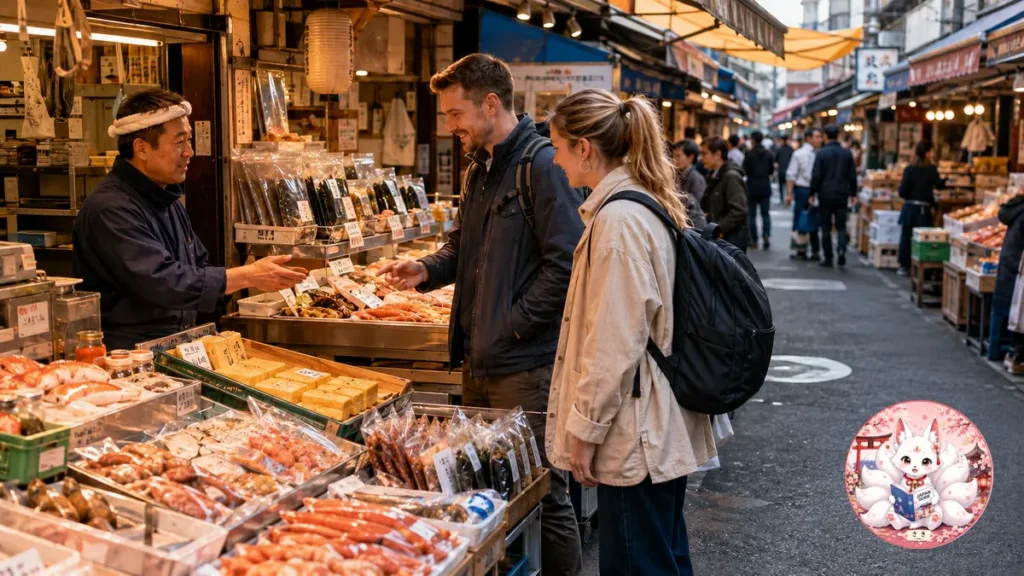
Tsukiji remains one of Tokyo’s best-known food districts, but older guidebooks can make it hard to know what is still there.
Tsukiji Outer Market in 30 Seconds
- The Tsukiji Outer Market is still open; the wholesale market and auctions moved to Toyosu.
- For a first visit, aim to arrive at about 9:00 a.m.
- Many businesses close on Sundays and on some Wednesdays, so check the calendar before going.
- Allow about two to three hours for a relaxed first visit.
- Bring some Japanese yen and leave large luggage at your hotel or in storage.
- Eat only where the shop permits, and ask before taking photos.
The wholesale market and tuna auctions moved from Tsukiji to Toyosu in 2018. The Tsukiji Outer Market, however, remains in Tsukiji. Its narrow streets are still lined with restaurants and specialist shops selling seafood, tamagoyaki, dried foods, tea, knives, tableware, and other products connected with Japanese food culture.
You do not need to arrive before sunrise or book a tour to enjoy it. For most first-time visitors, the simplest plan is to arrive around 9:00 a.m. and explore on your own. Choose the day carefully, remember that this is still a working market district, and follow the local rules for eating, photography, and luggage.
This guide explains when to go, what you can eat and buy, how Tsukiji differs from Toyosu, and how to plan a practical two- to three-hour visit.
Last checked: August 18, 2026.
Affiliate disclosure: This article contains an affiliate link. If you book through it, Life with Saki may earn a commission at no extra cost to you.
In this guide
Is Tsukiji Market Still Open?
Yes—but the name now refers to a different visitor experience from the one many older guidebooks describe.
The former Tokyo Metropolitan Central Wholesale Market in Tsukiji closed and moved to Toyosu in 2018. Wholesale auctions, including the tuna auction, now take place at Toyosu Market.
The surrounding businesses known collectively as the Tsukiji Outer Market remained in Tsukiji. The area continues to serve professional buyers, local shoppers, and visitors. It includes retail shops, wholesalers that sell smaller quantities to the public, restaurants, and businesses specializing in ingredients and kitchen equipment.
This distinction matters when planning your visit. Tsukiji is the easier choice if you want to eat, shop, and explore a compact food district in central Tokyo. Toyosu is the relevant destination if you want to observe a modern wholesale market or learn about the auctions.
Tsukiji or Toyosu: Which Should You Visit?
Neither market is automatically better. They serve different purposes.
| Your main goal | Better match | Why |
|---|---|---|
| Eat, shop, and explore a compact food district | Tsukiji Outer Market | Restaurants and specialist shops are concentrated along walkable streets |
| See the wholesale market or tuna auction | Toyosu Market | The wholesale and auction functions moved there in 2018 |
| Fit a food stop into plans near Ginza | Tsukiji Outer Market | Tsukiji is close to Ginza and served by several subway stations |
| Explore a large modern market facility | Toyosu Market | Toyosu has purpose-built wholesale and visitor facilities |
| Spend a casual morning eating and shopping | Tsukiji Outer Market | You can explore without planning around an auction schedule |
If this is your first trip and you simply want a morning centered on Japanese food, Tsukiji is usually easier to add to a central Tokyo itinerary. If the auction itself is important, start with the official Toyosu Market visitor information and check the current observation rules before choosing a date.
The Best Day and Time to Visit Tsukiji
Start at about 9:00 a.m.
The official calendar divides the day into three general periods:
- 6:00-9:00 a.m.: professional buyers’ hours
- 9:00 a.m.-2:00 p.m.: public buyers’ hours
- After 2:00 p.m.: flexible opening hours
These are broad guidelines, not shared opening hours. Some businesses open earlier, while others close before 2:00 or finish when they sell out.
For a first visit, 9:00 a.m. is a sensible starting point. You will arrive after the period when professional buyers have priority but early enough to explore before many businesses finish for the day.
Earlier is not always better. Professional buyers and workers have priority before 9:00, and carts and bicycles move through the narrow lanes. If you arrive early, stay alert and keep entrances and work routes clear.
At Tsukiji Uogashi, the wholesale facility within the outer market, shopping before 9:00 a.m. is limited to people with advance permission. General visitors can shop there after 9:00.
Plan lunch before the busiest part of the day
The market’s sample itinerary suggests lunch at about 11:00 a.m. That is a useful target because many restaurants are small and have limited seating.
Do not build the entire morning around one famous restaurant. If the line is much longer than expected, compare nearby menus and prices instead of spending most of your visit waiting.
Be careful with Sundays and Wednesdays
Many shops close on Sundays and on some Wednesdays, but there is no single closing schedule that applies to every business.
Before going, check both:
- The official Tsukiji Outer Market calendar
- The current business hours of any restaurant or shop you especially want to visit
An open day on the general market calendar does not guarantee that every individual shop will be open. National holidays and the year-end period can also affect schedules.
What Can You Eat at Tsukiji?
Seafood is the main attraction for many visitors, but Tsukiji is not limited to sushi and sashimi.
Sushi and seafood rice bowls
Sushi and kaisendon—rice bowls topped with sashimi—are two of the most recognizable choices. Menus, portion sizes, ingredients, and prices vary widely. Seasonal supply also affects what is available.
Check the displayed menu before joining a line. A photo may not show the exact portion, toppings, or current price. If you have a seafood allergy or need to avoid certain ingredients, ask before ordering rather than relying on appearance alone.
Tamagoyaki and smaller bites
Tamagoyaki is a rolled Japanese omelet and one of the easier foods to try in a small portion. Shops may make it sweet, savory, or with additional ingredients.
You will also find grilled seafood, fish cakes, fried foods, skewers, rice balls, and other snacks. Availability changes by shop and time of day, so avoid building your visit around a fixed food checklist.
Ramen, set meals, tea, and sweets
Seafood is not your only option. The official market directory includes ramen, light meals, cafes, tea, and sweets, as well as restaurants serving set meals.
This variety is useful for mixed groups, but it does not guarantee that every dietary requirement will be easy to manage. Dashi, sauces, and prepared foods may contain fish, meat, wheat, soy, or other ingredients that are not obvious from appearance alone.
Do not eat while walking through the market
Tsukiji is often described online as a street-food destination, but the official rule is clear: eat inside the business, directly in front of it when the shop provides space, or in another designated eating area.
Walking while eating can block the already narrow streets and create problems with spills and trash. After buying food, eat where the shop directs you and follow its instructions for disposing of containers, skewers, and napkins.
What Can You Buy Besides a Meal?
The outer market is still a shopping district, not only a collection of restaurants.
Dried foods and seasonings
Shops sell products used in Japanese cooking, including:
- Dried bonito flakes
- Nori and other seaweed
- Green tea
- Dried seafood
- Tsukudani, or foods simmered in a strongly flavored sauce
- Pickles
- Seasonings and other processed foods
Packaged, shelf-stable products are usually easier to carry than fresh seafood, but they are not automatically allowed through customs. Import restrictions vary by destination and may cover meat, seafood, plants, seeds, fresh produce, and other ingredients. Check your country’s rules before buying food specifically to take home.
Knives and kitchenware
Tsukiji also has shops specializing in knives, cooking tools, tableware, and packaging supplies. These can be more practical souvenirs for travelers who cook at home.
If you buy a knife, pack and transport it according to your airline, airport-security, and customs rules. Do not place it in carry-on luggage without confirming the applicable restrictions.
Fresh ingredients
Fresh fish, shellfish, vegetables, fruit, meat, and eggs reflect the area’s role as a working food market. They may be interesting to browse, but they are not always practical purchases for a hotel guest.
Before buying, consider refrigeration, preparation facilities, when you can eat the product, and any rules at your accommodation. Do not touch raw or unpackaged food unless the seller invites you to do so.
A Simple Three-Hour Tsukiji Itinerary
This route follows the market’s suggested sequence while leaving room to change plans.
9:00 a.m.: Start at Plat Tsukiji
Plat Tsukiji is the outer market’s information center. Pick up a map and ask about current shop openings, food categories, facilities, or anything specific you want to buy.
The information center offers English assistance. It is also useful for locating restrooms, lockers, the public lounge, and the designated smoking area.
Its listed hours differ between ordinary weekdays and market-closure days, so check the official Plat Tsukiji information if you expect to depend on a particular service.
9:15 a.m.: Visit Namiyoke Inari Shrine
Namiyoke Inari Shrine stands beside the market and has long been associated with the area’s merchants and food trade. A brief visit fits naturally into the morning.
Keep the visit respectful. The shrine is an active religious site, not simply a market decoration.
9:30 a.m.: Explore and shop
Explore without trying to cover every lane at once. Look at seafood, tamagoyaki, dried ingredients, tea, knives, and kitchenware while leaving room for workers, carts, bicycles, and other customers.
If you see something you want to eat, use the shop’s eating area before continuing. If you are considering a packaged souvenir, compare its size, storage requirements, and customs restrictions before buying.
11:00 a.m.: Have an early lunch
Choose sushi, a seafood bowl, a set meal, ramen, or another dish that fits your group. Check the full menu and payment methods before entering or lining up.
Small restaurants need to turn seats over during busy periods. Once you finish eating, avoid staying at the table longer than necessary when other customers are waiting.
Around noon: Continue to Ginza or another nearby stop
Two to three hours is enough for many first-time visitors. From Tsukiji, you can walk toward Ginza or visit Tsukiji Hongwanji Temple before continuing with the rest of your day.
Finishing around noon leaves the afternoon open and gives you flexibility if more shops than expected are closed or the weather makes the market less comfortable.
Self-Guided Visit or Guided Food Tour?
Most travelers can explore Tsukiji Outer Market without a tour. The official map, shop displays, and the route above are enough for a straightforward morning.
Choose a self-guided visit if you want flexibility
A self-guided visit is usually better when you want to:
- Decide how much to spend on food
- Choose your own restaurants and snacks
- Leave a long line and try somewhere else
- Spend more time shopping for knives, tea, or packaged ingredients
- Combine Tsukiji with a flexible day around Ginza
You can also start at Plat Tsukiji if you need English help finding a particular type of shop.
Consider a guided tour if you want explanations and structure
An English-guided tour may be useful if you want more context about the market and its food culture, help navigating the lanes, and a set itinerary.
One current Klook option is the Tsukiji Fish Market Food and Walking Tour, a two-hour English-guided group tour. When checked, Klook showed a 4.9 rating from 320 reviews and more than 3,000 bookings. That booking history gives you more customer feedback to review, but popularity alone does not make it the right choice for everyone.
Do not assume the displayed starting price includes all food. What you taste or purchase may depend on the package and your choices. Before booking, confirm:
- Exactly which food or drinks are included
- How much additional cash you may need
- The meeting point and start time
- The group size
- Cancellation terms
- Allergy and dietary-request handling
Guided tour option
Prefer a structured introduction with an English-speaking guide? Review the latest inclusions, meeting point, availability, and cancellation terms before booking.
Would you rather make sushi than take a food tour? Life with Saki’s guide to English-friendly cooking classes in Tokyo includes a chef-led sushi class in Tsukiji. It is a cooking experience, not a guided market tour.
Eight Rules to Follow at Tsukiji
The market’s official visitor guidance emphasizes eight points.
1. Give professional buyers priority before 9:00 a.m.
Do not block shop entrances, delivery routes, or people moving products. Stay aware of carts, bicycles, and work vehicles.
2. Eat where the shop tells you to eat
Use the restaurant, the shop’s designated frontage, or another eating area. Do not carry uncovered food through the lanes while eating it.
3. Leave large luggage elsewhere
Suitcases and large bags obstruct the narrow streets. Store them before arriving rather than relying on the market to have space.
If your hotel cannot hold your bags, see Life with Saki’s guide to luggage storage in Tokyo before check-in or after checkout.
4. Move in a small group
The lanes and shops are not designed for a large group to stop together. If you are traveling with several people, avoid forming a line across the street or gathering in front of a counter.
5. Ask before taking photos
Request permission before photographing a shop, products, or staff. Follow any no-photography signs. Buying something does not automatically give permission to photograph the person who served you.
6. Do not touch the food
Raw seafood and other products are valuable stock. Ask the seller if you need help inspecting or choosing something.
7. Do not bargain
Price negotiation is not customary at Tsukiji. Pay the displayed price or choose another product.
8. Smoke only in the designated area
Street smoking is prohibited in Chuo City. Plat Tsukiji has the market’s designated smoking area.
Cash, Cards, English, and Luggage
Should you bring cash?
Yes. Some shops accept cards or other cashless payments, but acceptance varies by business, and many shops still accept Japanese yen only. Plat Tsukiji currently has a Seven Bank ATM and a currency exchange machine, but bringing some yen in advance will make smaller purchases easier.
Bring enough yen for smaller food and shopping purchases. If you need to withdraw cash with an overseas-issued card, read Life with Saki’s guide to using ATMs in Japan before your visit.
Is English available?
Some workers speak English, and some restaurants provide English or multilingual menus. Support varies by shop.
Plat Tsukiji offers English assistance. A translation app can help with simple questions at individual shops.
Are lockers available?
There are coin lockers at Plat Tsukiji, including some intended for larger bags, but the number of suitcase-sized lockers is limited. Check the current facility hours before relying on them.
Treat these lockers as a backup. Leave a suitcase at your hotel, a station, or another storage facility before traveling to the market.
What about strollers?
The official market guidance asks visitors to avoid bringing strollers into the narrow streets when possible. Plat Tsukiji lists temporary stroller storage for ¥500 per stroller at the time of checking.
Recheck the service and price before depending on it. If you keep a child with you in the market, hold their hand and stay alert around carts, bicycles, wet floors, and crowded shop entrances.
What should you wear?
Wear stable, closed-toe shoes. Market floors can be wet and slippery, and the official guidance advises against high heels and sandals.
Choose clothing that works for the day’s weather but does not make it difficult to move through a small restaurant or crowded lane. In summer, carry water and take breaks; in rain, allow extra time on wet surfaces.
How to Get to Tsukiji Outer Market
The market is served by three useful subway stations.
From Tsukiji-shijo Station
- Line: Toei Oedo Line
- Official walking estimate: about one minute
From Tsukiji Station
- Line: Tokyo Metro Hibiya Line
- Official walking estimate: about one minute
From Higashi-ginza Station
- Lines: Toei Asakusa Line and Tokyo Metro Hibiya Line
- Official walking estimate: about three minutes
The easiest station depends on your starting point. Check the exit and walking route, not just the station name: Tsukiji and Tsukiji-shijo are different stations on different lines.
Use the official Tsukiji access page to confirm the market location. On the day, use current transit information for delays or service changes.
Before You Go: Tsukiji Checklist
- Check the official market calendar
- Check the individual hours of any must-visit shop
- Plan to arrive at about 9:00 a.m.
- Bring some Japanese yen
- Store your suitcase before traveling to the market
- Wear closed-toe, slip-resistant shoes
- Save the official map or pick one up at Plat Tsukiji
- Eat only in the shop or its designated space
- Ask before taking photos
- Check customs rules before buying food to take overseas
- Confirm tour inclusions separately if you book a guided experience
Frequently Asked Questions
Is Tsukiji Outer Market still open?
Yes. The Tsukiji Outer Market remains open. The former central wholesale market and its auction functions moved to Toyosu in 2018.
Can you see the tuna auction at Tsukiji?
No. Tuna auctions take place at Toyosu Market. Check Toyosu’s official visitor information for current viewing rules and schedules.
What time should tourists visit Tsukiji?
Around 9:00 a.m. is the most practical starting time for a first visit. The official calendar identifies 9:00 a.m. to 2:00 p.m. as public buyers’ hours, while 6:00 to 9:00 a.m. is intended for professional buyers.
Is Tsukiji open on Sundays?
Some businesses open on Sundays, but many are closed. Some Wednesdays are also market closing days. Check the official calendar and the individual shop’s schedule before visiting.
How long do you need at Tsukiji?
Two to three hours is enough for many first-time visitors to explore, try one or two smaller foods, shop, and have an early lunch. Add more time if you plan to wait for a specific restaurant or join an activity.
Do you need a reservation to visit?
You do not need a general admission reservation to walk through the Tsukiji Outer Market. Individual restaurants, classes, and guided tours may require or accept reservations.
Can you use credit cards at Tsukiji?
It depends on the business. Some accept cards or cashless payment, while many still accept Japanese yen only. Bring cash and check before ordering or buying.
Can you bring a suitcase?
You should avoid it. The streets and shops are narrow, and the official market guidance asks visitors to leave large luggage elsewhere. Lockers exist near Plat Tsukiji, but suitcase-sized spaces are limited.
Is Tsukiji suitable for vegetarians?
There are non-seafood foods, drinks, sweets, and shops, but vegetarian requirements may be difficult to confirm because dashi and sauces can contain fish or meat. Ask about ingredients rather than judging by appearance alone.
Final Recommendation
For a first visit, arrive around 9:00 a.m., start at Plat Tsukiji, and plan an early lunch around 11:00. Two to three hours is enough for most travelers.
You can explore on your own or book a guided food walk if you value English explanations and a set route. Either way, check the current calendar and any must-visit shop before going. Bring some cash, leave large luggage elsewhere, eat only where the shop permits, and ask before taking photos.
Most importantly, remember that Tsukiji Outer Market is still active even though the wholesale market and tuna auctions have moved to Toyosu. Treat it as a working food district, not just a tourist attraction, and the morning will be easier for both you and the people who work there.
Related Guides
English-Friendly Cooking Classes in Tokyo
Compare sushi, ramen, home-cooking, and other hands-on classes for first-time visitors.
Find practical options for storing bags before check-in or after checkout.
Learn where overseas-issued cards work and how to avoid common withdrawal problems.