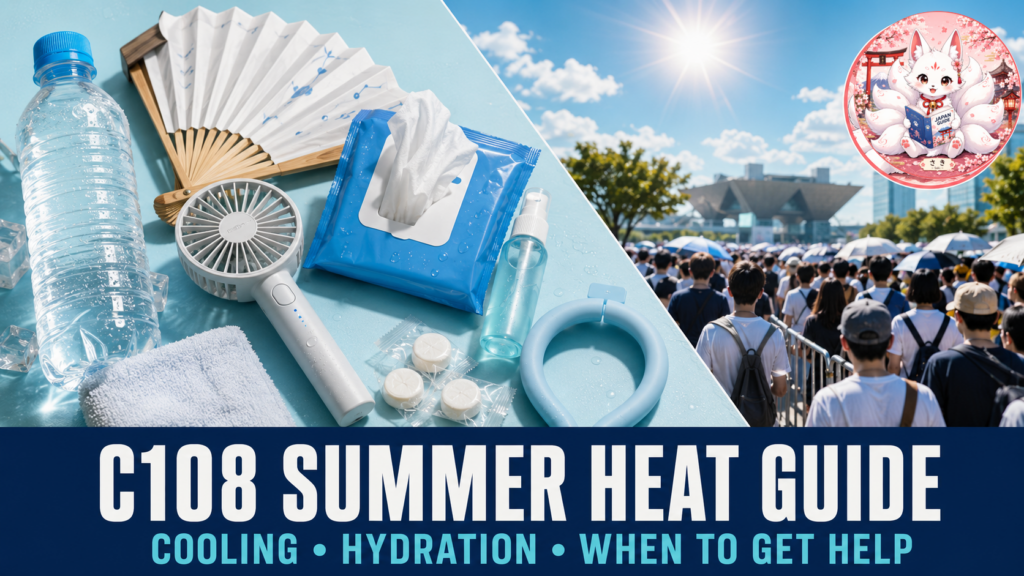
Comic Market 108 takes place at Tokyo Big Sight on August 15 and 16, 2026. Summer Comiket heat is not only an outdoor problem: humidity, crowded halls, waiting lines, and long walks between areas can all add to the strain.
This guide focuses on two decisions: what to use for heat protection, and when to stop, leave a line, or get help. For admission details, read the C108 tickets and entry guide. For trains and stations, use the Tokyo Big Sight access guide.
The Japanese C108 heat-safety page was updated on July 26, 2026, after the English version was updated on July 10. This article uses the newer Japanese page where the two versions differ. Last checked: July 29, 2026.
The short version: Check Tokyo’s WBGT before leaving, carry a drink, and get more before entering the East area. Leave the line as soon as heat-illness symptoms appear. If someone cannot drink without help or is not responding normally, call an ambulance immediately.
Check WBGT Before You Decide to Go
Do not judge the day by air temperature alone. Japan’s Wet Bulb Globe Temperature, or WBGT, is a heat-stress index that reflects factors including humidity and radiant heat. The Ministry of the Environment classifies WBGT 31 or above as “Danger” for exercise. That threshold is not a Comiket cancellation rule, but it is a clear warning that ordinary plans may be too demanding.
A Heat Stroke Alert is issued for a region when WBGT is forecast to reach 33 or higher. The alert is announced at 5:00 p.m. the previous day and again at 5:00 a.m. on the day, based on the latest available predictions. The Ministry of Health, Labour and Welfare advises people to avoid going outdoors whenever possible when an alert has been issued.
Check the Tokyo forecast the evening before C108 and again that morning. If an alert is active, or if you are already sick, sleep-deprived, unusually tired, or affected by a condition that increases your heat risk, reconsider attending, shorten your visit, or change your plan. A ticket is not a reason to push through unsafe conditions. If you have a chronic condition or take medication, follow your doctor’s advice; the C108 organizers also ask participants to bring their regular medication, medication record, and Japanese health-insurance eligibility information when applicable.
Why C108 Needs Extra Heat Planning
The C108 organizers warn that general attendees may spend longer in lines and walk farther than usual. Construction affects how the event uses the East halls, and the route from the West and South areas to the East area includes a long outdoor section. Plan for heat exposure even after you have entered the venue.
Important for the East area: C108’s official Japanese heat-safety page says there will be no operating convenience store in the East area because of the East 4–6 Hall renovation. The organizers strongly recommend getting drinks before entering East. They also direct attendees to venue vending machines and catering in the truck yard, but recommend obtaining drinks before entering East rather than relying on those options.
The organizers recommend drinking small amounts regularly, about every 30 minutes to one hour, before you feel thirsty, and not restricting fluids to avoid restroom visits. If you stop to cool down, do not block a passage, emergency exit, or staff operation.
If you are moving between areas, refill first and follow the current staff route rather than an ordinary venue map. The main C108 guide covers the wider event plan; this article stays focused on heat decisions and cooling products.
Build a Heat-Safety Kit
A heat-safety kit should reduce exposure, support regular drinking, and help you cool down during a break. It does not need to include every summer product in a drugstore.
| Purpose | Useful items | How to think about them |
|---|---|---|
| Hydration | Water or another suitable drink | Bring a drink and plan where to refill before entering East. There is no single correct bottle count for every person and forecast. |
| Shade and clothing | Wide-brimmed hat, light-colored quick-drying clothing, parasol | A parasol can help in direct sun, but staff may ask you to fold it in crowded areas. |
| Physical cooling | Cold pack, frozen drink, wet towel, neck cooler, portable fan | Use these during breaks and combine them with shade, airflow, and hydration. |
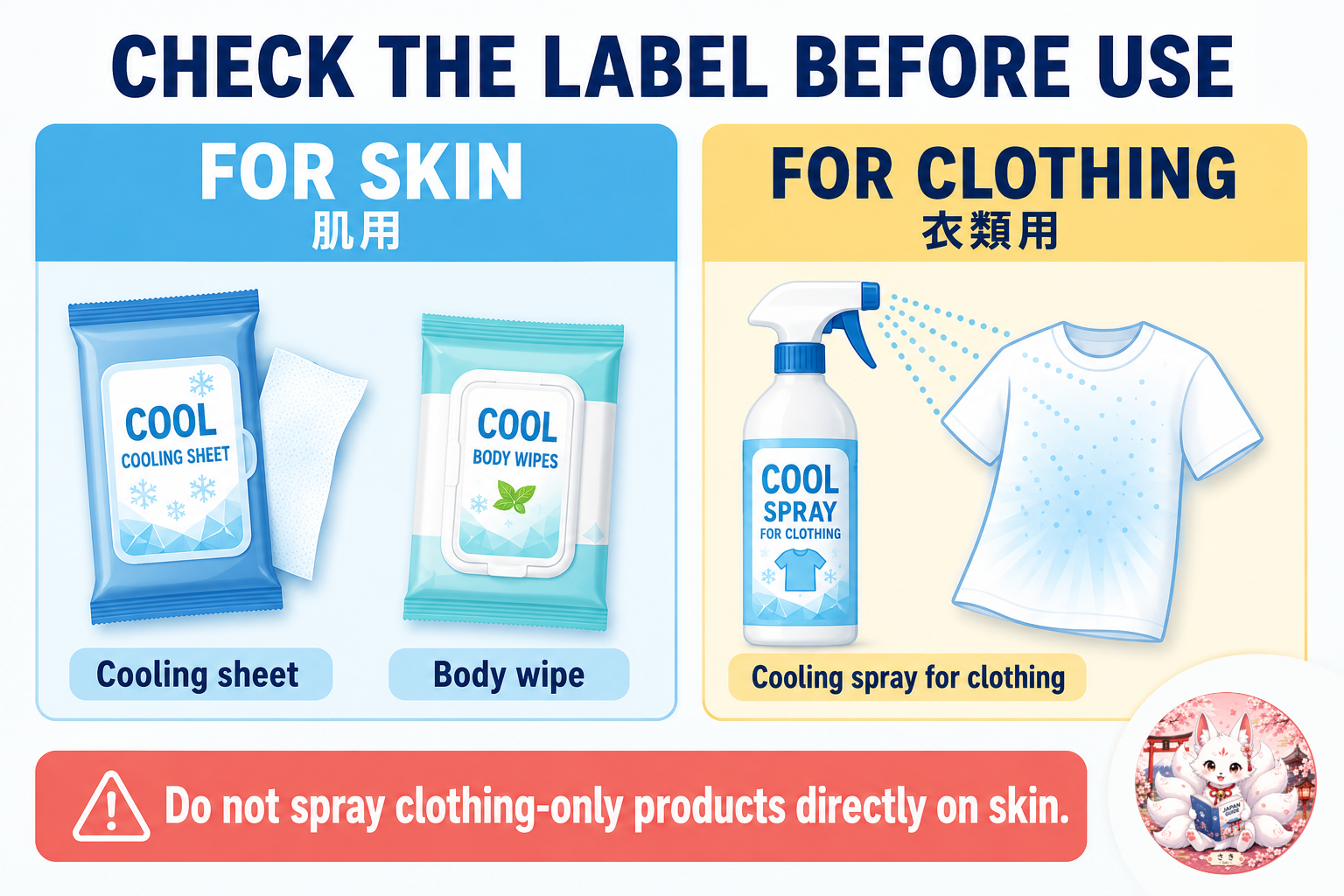
| Cooling comfort | Cooling sheet, body wipe, cooling spray for clothing | Read the intended use. A cool sensation does not prove that your body temperature is safe. |
| UV protection | Sunscreen, hat, long sleeves | Use several forms of protection rather than relying on sunscreen alone. |
| Personal health | Regular medication and relevant health information | Keep essential medicine with you and follow medical instructions that apply to you. |
For drinks purchased before the event, the Japanese supermarket guide explains store basics, while the convenience store guide can help with a last-minute stop.
Japanese Labels to Recognize
| Japanese | Meaning |
|---|---|
| 冷感シート | Cooling sheet |
| ボディシート | Body wipe |
| 衣類用冷感スプレー | Cooling spray for clothing |
| 保冷剤 | Cold pack |
| ネッククーラー | Neck cooler |
| 日焼け止め | Sunscreen |
| 肌用 | For use on skin |
| 衣類用 | For use on clothing |
These words are included only to help you identify product types.
Cooling Products and Sunscreen: Use Them Safely
Cooling products can make a hot day more manageable, but treat them as support tools. A menthol sensation may make you feel cooler, but that feeling alone is not a heat-safety check. Keep taking breaks, drinking regularly, and watching for symptoms even if your skin feels cool.
- Check whether a product is labeled for skin or clothing. Do not spray a clothing-only product directly on your skin.
- Some cooling wipes and sprays contain menthol, alcohol, or fragrance. Check the ingredients and warnings if you have sensitive skin, an allergy, or alcohol sensitivity.
- Try a new skin product on a small area before using it widely. Do not begin with a strong unfamiliar product across a large area on the morning of C108.
- Stop using the product if you develop a burning sensation, itching, redness, pain, swelling, or another unusual reaction. Seek medical advice when the symptoms require it.
Sunscreen for a Long Event Day
SPF mainly indicates protection against UVB-related sunburn, while PA indicates UVA protection. Choose a product for strong outdoor exposure, apply enough to cover the skin evenly, and use a hat and clothing as well. The Japan Cosmetic Industry Association recommends checking the condition of the sunscreen and reapplying at least every two to three hours as a guide because sweat, water, and friction can remove it.
Japan’s “UV water resistance” label refers to maintaining sun protection after water exposure; it does not show resistance to sweat. Read the product’s own claims and directions instead of treating the water-resistance mark as a promise for an entire Comiket day.
Do Not Use Oral Rehydration Solution as an Everyday Drink
Oral rehydration solution, labeled 経口補水液, is not an everyday hydration drink. It contains more sodium and potassium than ordinary soft drinks, including many sports drinks. Japan’s Consumer Affairs Agency warns against drinking it routinely or in large amounts. Check that the package is labeled for heat-related dehydration. If you have a medical condition or restrictions on fluids or sodium, follow the advice of your doctor, dietitian, or pharmacist.
Stop, Leave the Line, or Get Help
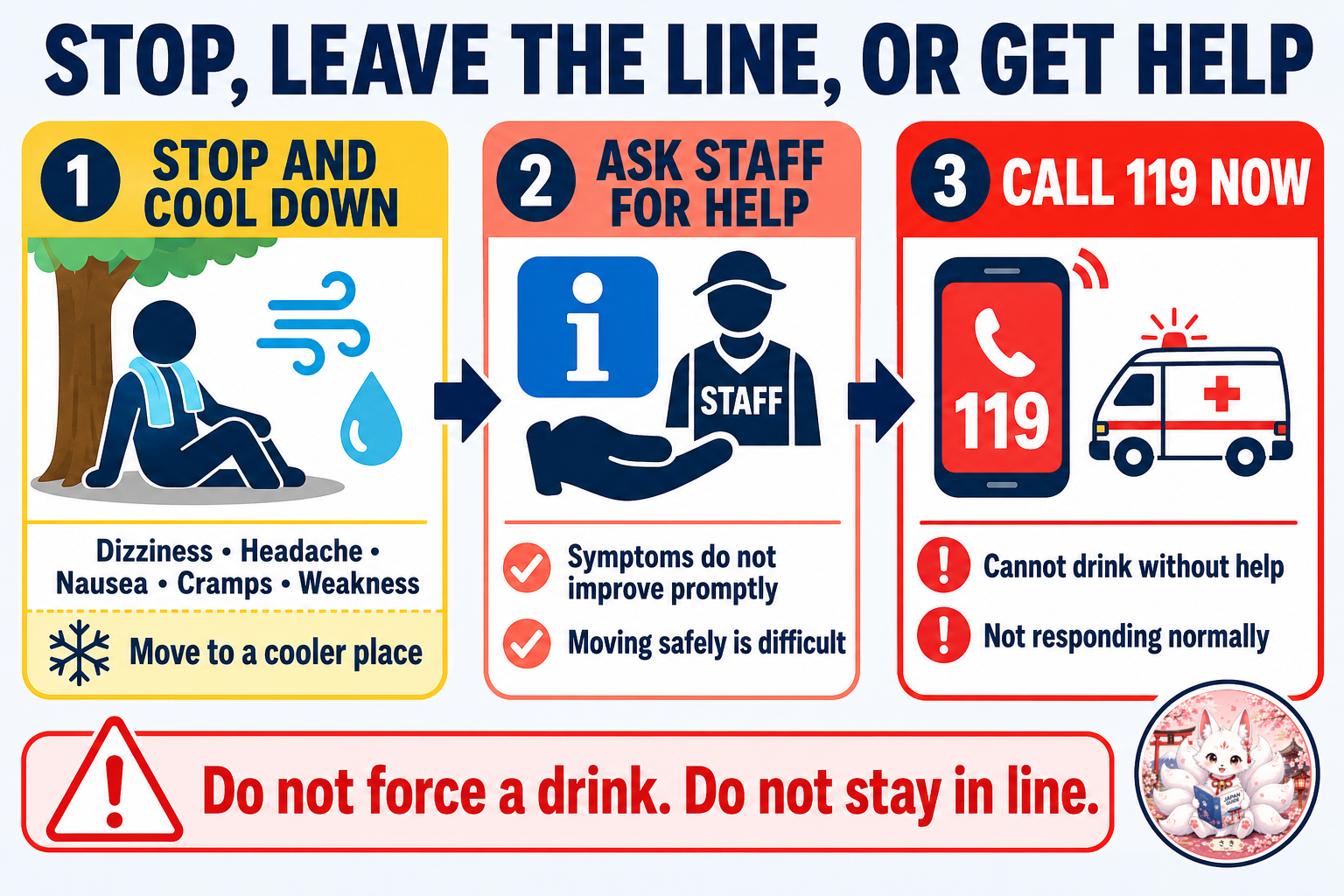
A valuable place in line is not worth waiting for symptoms to become severe. Stop moving or waiting and go to a cooler place if you develop dizziness, lightheadedness, headache, nausea, vomiting, muscle pain or cramps, unusual weakness, heavy sweating, or difficulty concentrating or standing normally.
Loosen tight clothing and cool the body, especially around the neck, under the arms, and at the groin. If the person is fully alert and can drink without help, offer an appropriate drink in small amounts. Ask event staff for help if symptoms do not improve promptly or if moving safely is difficult.
Call an ambulance immediately if the person cannot drink without help or is not responding normally. This matches the emergency criteria in Japan’s Ministry of Health, Labour and Welfare guidance. Loss of consciousness, clearly impaired judgment, an abnormal response, or worsening severe symptoms also require urgent help. Ask nearby staff to call 119 and guide responders. Do not force a drink into someone who cannot safely drink.
This is general first-aid guidance, not a diagnosis. When in doubt, stop the activity and seek help early rather than trying to decide whether the symptoms are “serious enough” while remaining in the line.
First Aid Rooms at C108
| Location |
|---|
| East 1 Hall Organizer’s Office |
| Conference Tower, 1st floor |
| South 1 Hall, 2nd floor |
Hours for all three rooms: 7:30 a.m.–6:00 p.m.; until 4:00 p.m. on Day 2.
C108’s first aid rooms provide basic first aid; they are not medical facilities. If symptoms are not improving, the organizers advise leaving early or going to a hospital. Do not spend extra time searching for a room if the situation is an emergency—contact the nearest staff member and call 119.
Conclusion
Prepare cooling products by purpose, check WBGT before committing to the trip, and secure drinks before entering the East area. Most importantly, treat early symptoms as a reason to stop: leaving a line early is far better than waiting until you cannot leave safely.