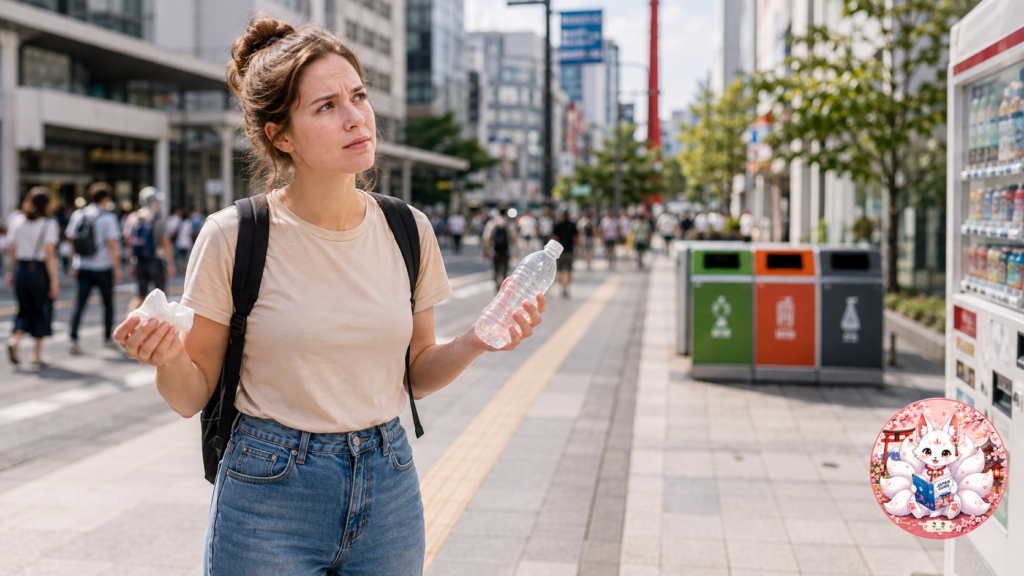
You finish a drink, look around for a trash can, and find…nothing.
If this happens during your first trip to Japan, you are not imagining the problem. Public trash cans can be surprisingly hard to find, even in busy sightseeing areas.
Last checked: August 20, 2026. Disposal rules and available bins can vary by location and facility.
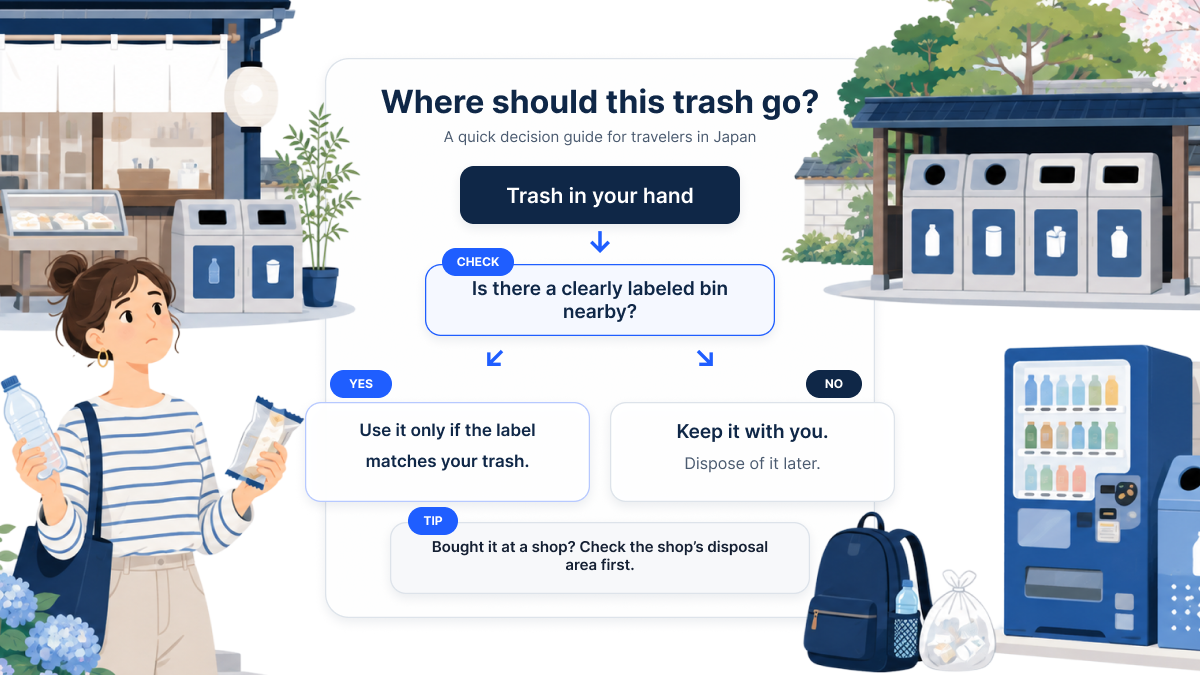
The simple rule: if you find a clearly labeled bin that is meant for your type of waste, use it. If you do not, keep the trash with you until you find an appropriate place to dispose of it.
The Short Answer: Where Can You Throw Away Trash?
At the shop or food stall
Use its designated disposal area if one is provided.
At a station or attraction
Use a visitor bin only when your waste matches the label.
Beside a vending machine
Use the recycling box only for the beverage containers it accepts.
No suitable bin nearby
Keep it with you and dispose of it later.
Tokyo and Kyoto’s official visitor guidance both recommend carrying a small trash bag when necessary and taking waste with you when suitable bins are unavailable.
Start With the Place Where the Trash Came From
For food, drinks, and takeout packaging, the easiest disposal option is often the business that sold the item to you—when it provides a disposal area. A food stall may have a bin nearby, a café may ask customers to return trays and cups, and an attraction may separate waste near its eating area.
Follow the system the business provides rather than looking for one universal Japan-wide rule. If you are visiting Tokyo’s famous market area, see our Tsukiji Outer Market Guide for the specific eating and waste etiquette there.
Vending-Machine Recycling Boxes Are Not Trash Cans
You will often see a box beside a drink vending machine. It may look like a convenient place to throw away whatever is in your hand, but it is not a general-purpose trash can.
Use it only for the beverage containers shown on the box. Food containers, napkins, batteries, cigarette waste, and other general trash do not belong there.
The Japan Soft Drink Association describes these as recycling boxes for empty beverage containers and has been working to reduce contamination by non-beverage waste. Check the pictures or labels on the opening, empty the drink first, and if the box is full, carry the container until you find another appropriate place.
Can You Throw Trash Away at a Convenience Store?
Do not treat convenience stores as public dumping points.
Some stores provide customer trash cans and some do not. If a store provides an accessible bin, check the labels and use it only for appropriate waste. If you brought the trash from somewhere else, do not automatically assume the store wants you to dispose of it there.
For shopping, payment, ATMs, heating food, and other basics, see our How to Use a Japanese Convenience Store guide.
What About Train Stations, Malls, and Tourist Attractions?
Some stations, commercial buildings, attractions, museums, and other facilities provide trash or recycling bins. Others provide very few—or none. Look for a clearly designated visitor bin, read the label or pictures, and use only the matching section. If nothing appropriate is available, keep your trash.
How to Read Common Trash-Bin Labels
| Japanese | Meaning | What to do |
|---|---|---|
| 燃えるごみ / 可燃ごみ | Burnable waste | Use only when the bin specifically accepts it |
| 燃えないごみ / 不燃ごみ | Non-burnable waste | Follow the facility’s examples or pictures |
| 缶 / かん | Cans | Usually for the type of cans shown |
| びん | Glass bottles | Use only when glass bottles are accepted |
| ペットボトル | PET bottles | For eligible PET bottles—not all plastic |
| 紙 | Paper | Use only when the bin specifically collects paper |
Do not treat this table as a nationwide sorting rule. Waste-separation rules differ by municipality and facility. The label on the actual bin is more important than a general travel guide.
A PET-Bottle Bin Is Not a Plastic Bin
ペットボトル means PET bottles. It does not mean “put every plastic object here.” Plastic cups, food packaging, shopping bags, utensils, and other plastic items may be handled differently depending on the facility or local system.
What Should You Do With Takeout Food Waste?
Takeout creates some of the most awkward tourist trash: skewers, cups, trays, wrappers, napkins, and containers with food residue. The best approach is to think about disposal before walking away from the shop.
- Check for a return counter or customer trash can.
- Look for a designated eating area.
- Follow any separate container or skewer disposal instructions.
- Do not push the packaging into an unrelated business’s bin without checking.
No Trash Can? Carry It
This is the habit that makes the biggest difference. Tokyo’s official visitor guidance tells travelers that when no suitable trash can is nearby, they should carry their trash with them. A small bag is enough for most sightseeing days, and a resealable bag is useful for anything damp, sticky, or strongly scented.
Can You Take Trash Back to Your Hotel?
For ordinary small amounts of trash generated during sightseeing, taking it back to your accommodation is a practical fallback. Once there, follow the hotel’s disposal setup. If you have something unusual—such as batteries, electronics, broken luggage, or a very large item—ask the front desk instead of putting it into a normal room bin.
Four Mistakes to Avoid
Using a vending-machine box for general trash
It is for the beverage containers shown on the box.
Leaving trash beside a full bin
Keep it with you and find another appropriate disposal point.
Assuming every convenience store takes outside trash
Use only what the store provides and allows.
Ignoring the labels
Sorting categories are not identical everywhere.
Do Not Use Residential Garbage Collection Points
While walking through a residential neighborhood, you may see bags, nets, cages, or collection areas used by local residents. These are not automatically public trash cans for tourists. Household garbage collection follows local schedules and sorting systems, so leave residential collection points alone unless your accommodation specifically instructs you to use one.
Why Are There So Few Trash Cans in Japan?
There are many explanations online, but a traveler does not need one simplified historical story. The useful present-day fact is that public trash cans can be limited, and Japanese tourism organizations explicitly tell visitors to be prepared to carry waste.
The Japan Tourism Agency’s fiscal 2025 survey, conducted from November 2025 through January 2026 at five major airports, found that 17.2% of respondents reported a lack of trash cans as a problem during their visit—the highest-ranked issue in the survey.
A Simple Setup for Your Day Bag
One small trash bag
For ordinary wrappers, tissues, and dry packaging.
One small resealable bag
Useful for anything damp, sticky, or strongly scented.
Frequently Asked Questions
Are there trash cans at train stations in Japan?
Some stations have trash or recycling bins and others have limited facilities. Do not plan your day on the assumption that every station will have one.
Can I put food wrappers in the box next to a vending machine?
No. Those recycling boxes are intended for the empty beverage containers shown on the box, not general food packaging.
Can I throw trash away at a convenience store?
If the store provides an appropriate customer trash can, follow its labels and instructions. Do not assume every store provides public disposal for trash brought in from elsewhere.
Should I carry my trash with me in Japan?
If there is no appropriate bin nearby, yes. Official tourism guidance for visitors recommends carrying waste until you find a suitable place or return to your accommodation.
Do I need to separate trash in Japan?
Yes when the disposal point provides separate categories. Follow the labels and pictures on the bin you are using.
Saki’s simple rule: If you cannot clearly tell that a bin is meant for the trash in your hand, do not guess. Keep it with you and dispose of it later.
The Takeaway
Japan can feel unusual at first because busy streets can have surprisingly few public trash cans. But the system becomes easier once you stop expecting to find a general-purpose bin everywhere.
Use the correct labeled bin when one is available. Use vending-machine recycling boxes only for the beverage containers they accept. Follow the disposal system at shops and attractions. And when no suitable option exists, carry your trash until you find one or return to your accommodation.
Official references: Japan Tourism Agency · JNTO · GO TOKYO · Kyoto City Official Travel Guide · Japan Soft Drink Association